Frankenstein (1931)

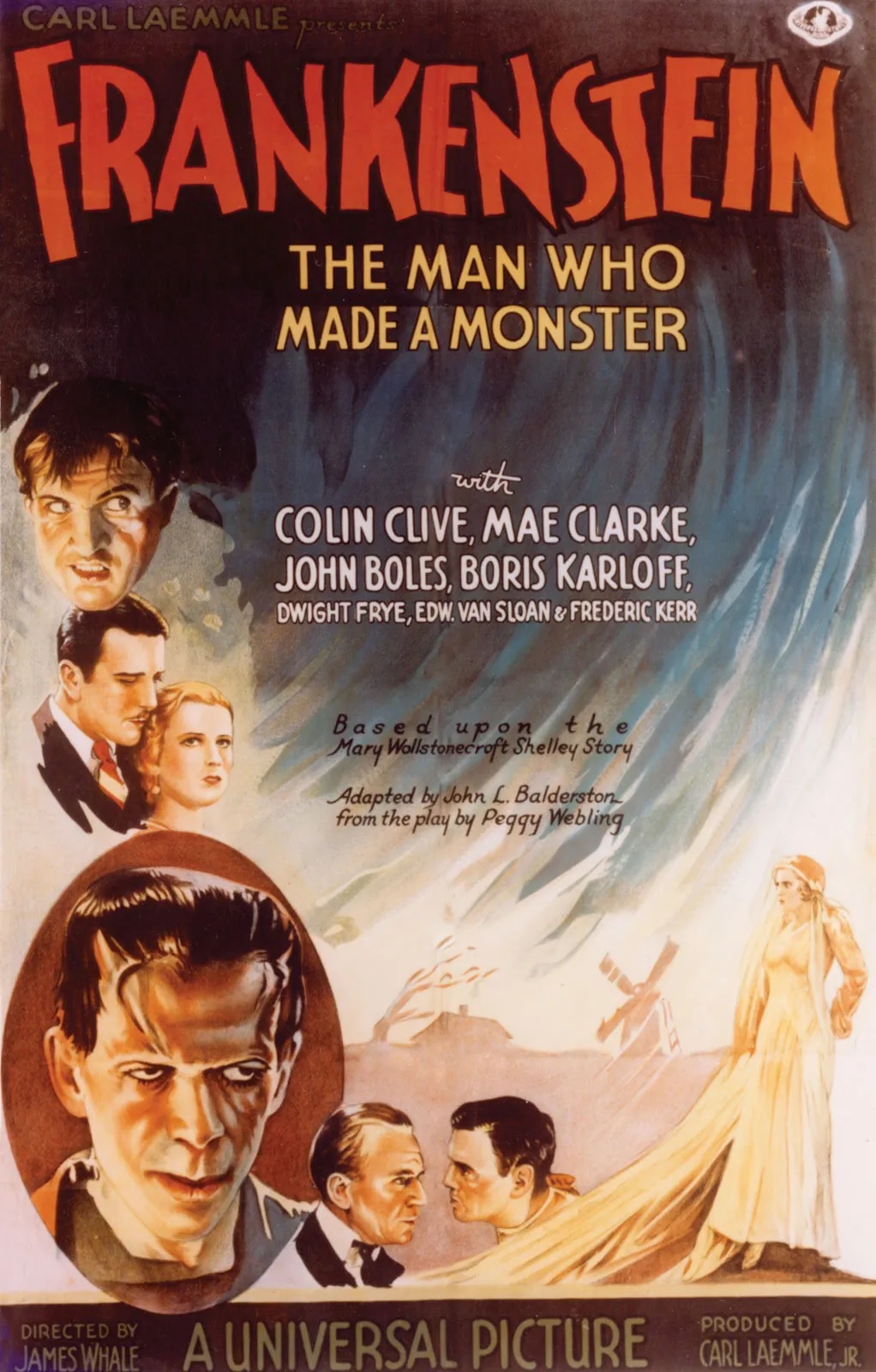
Still regarded as the definitive film version of Mary Shelley's classic tale of tragedy and horror, Frankenstein made unknown character actor Boris Karloff a star and created a new icon of terror. Along with the highly successful Dracula, released earlier the same year, it launched Universal Studio's golden age of 1930s horror movies. The film's greatness stems less from its script than from the stark but moody atmosphere created by director James Whale; Herman Rosse's memorable set designs, particularly the fantastic watchtower laboratory, featuring electrical equipment designed by Kenneth Strickfaden; the creature's trademark look from makeup artist Jack Pierce, who required Karloff to don pounds of makeup and heavy asphalt shoes to create the monster's unique lurching gait; and Karloff's nuanced performance as the tormented and bewildered creature. Frankenstein was greeted with screams, moans, and fainting spells upon its initial release, obliging Universal to add a disclaimer in which Edward Van Sloan advises the faint of heart to leave the theater immediately. If they don't: "Well...we've warned you." Director James Whale was memorably embodied by Ian McKellen in the Oscar-winning 1998 biopic Gods and Monsters.
A Monster Science Created - But Could Not Destroy!
Doctor Waldman: You have created a monster, and it will destroy you!
Backlot, Universal Studios - 100 Universal City Plaza, Universal City, California, USA
Busch Gardens - S. Grove Avenue, Pasadena, California, USA
(convalescent scene)
Lake Sherwood, California, USA
(creature and young girl by the lake scene)
Los Angeles, California, USA
Pasadena, California, USA
(convalescent scene)
San Fernando Valley, Los Angeles, California, USA
Sherwood Forest, California, USA
(creature and young girl by the lake scene)
Sherwood Lake, California, USA
(creature and young girl by the lake scene)
Universal Studios - 100 Universal City Plaza, Universal City, California, USA
(studio)
In one scene, the Monster (Boris Karloff) walks through a forest and comes upon a little girl, Maria, who is throwing flowers into a pond. The monster joins her in the activity but soon runs out of flowers. At a loss for something to throw into the water, he looks at Maria and moves toward her. In all American prints of the movie, the scene ends here. But as originally filmed, the action continues to show the monster grabbing Maria, hurling her into the lake, then departing in confusion when Maria fails to float as the flowers did. This bit was deleted because Karloff - objecting to the director's interpretation of the scene - felt that the monster should have gently put Maria into the lake. This scene is restored in the videocassette reissue.
Bela Lugosi was offered the role of the monster, but refused on the grounds that his character would not speak (though he eventually played the role in Frankenstein Meets the Wolf Man (1943)). Lugosi also insisted on creating his own makeup for the Monster, but his design was rejected. According to film historian Richard J. Anobile, Lugosi was originally offered the role of Dr. Frankenstein by original director Robert Florey, but Carl Laemmle insisted that Lugosi play the monster. Test footage of Lugosi in Monster make-up was filmed by Florey on the set of Dracula (1931). Soon after, Florey was replaced by James Whale as director, and Lugosi was replaced by Karloff.
Those originally considered for the cast included Leslie Howard as Henry Frankenstein and Bette Davis as Elizabeth. Director James Whale insisted on Colin Clive for the role of Henry.
John Carradine turned down the part of the Monster because he considered himself too highly trained to be reduced to playing monsters.
After bringing the monster to life, Dr. Frankenstein uttered the famous line, "Now I know what it's like to BE God!" The movie was originally released with this line of dialogue, but when it was re-released in the late '30s, censors demanded it be removed on the grounds that it was blasphemy. A loud clap of thunder was substituted on the soundtrack. The dialogue was partially restored on the video release, but since no decent recording of the dialogue could be found, it still appears garbled and indistinct. The censored dialog was partially returned to the soundtrack in the initial "restored version" releases. Further restoration has now completely brought back this line of missing dialog. A clean recording of the missing dialog was reportedly found on a Vitaphone disc (similar to a large phonograph record). Modern audio technology had to be used to insert the dialog back into the film without any detectable change in the audio quality.
According to the TLC network program "Hunt for Amazing Treasures", a unique six-sheet poster for the original 1931 release, showing Karloff as The Monster menacing Mae Clarke, is worth at least $600,000 US and is possibly the most valuable movie poster in the world. The only known (original) copy is owned by a private collector.
Karloff offered to remove his partial bridgework as part of the monster make-up process to create the sunken cheek look.
Ken Strickfaden, who created all the electrical effects for the movie, also doubled for Boris Karloff during the sequences that showed the million volt sparks playing over his body. The same machines were later used in the comedy Young Frankenstein (1974).
Child actress Marilyn Harris had done several takes of the drowning scene, none of which turned out quite right. Although wet and tired, she agreed to do one last take of the scene, the one that appears in the finished film, after director James Whale promised her anything she wanted if she would do so. She asked for a dozen hard-boiled eggs, her favorite snack. Whale gave her two dozen. The DVD commentary for the film suggests that Harris wasn't actually a good swimmer, quoting Harris as saying that she had only a couple of swimming lessons before filming and had never dived under water before.
John Huston wrote an early version of the warning speech given at the start of the film.
The method of animating the creature is never discussed in Mary Shelley's novel. In the book, Frankenstein, narrating, refuses to divulge how he did it so no one can re-create his actions. However, the use of lightning to resurrect the monster has become the accepted methodology and appears in virtually every Frankenstein movie since.
According to The People's Almanac, at one point the movie was to have included a line of dialogue giving the Monster the name, Adam. The Almanac indicates that an early print of this film may have indeed been released with just such a scene, but that it was cut when audiences began referring to the Monster by the name Frankenstein.
John Carradine, who later played Dracula in the Universal horror films, once claimed he was considered for the role of the Monster.
The Monster in this film does not physically resemble Mary Shelley's character. It was make-up artist Jack P. Pierce who came up with innovations such as the Monster's flat head, the bolts through the neck, the droopy eyelids, and the poorly-fitted suit. Any future Frankenstein film that features any of these physical abnormalities is taking its inspiration from Pierce's make-up work.
The popular image of Frankenstein's monster as green-skinned was sourced in this film. Actually, Jack P. Pierce's monster make-up gave the monster yellow skin, one of the few consistencies from Mary Shelley's original description of the monster.
Some of the sets had originally been constructed for Paul Leni's The Cat and the Canary (1927) which Universal had produced four years earlier.
What are commonly called bolts on the neck of the monster are in reality electrodes.
The film was banned in Kansas upon its original release on the grounds that it exhibited "cruelty and tended to debase morals".
A 20-minute test reel, starring Bela Lugosi as the monster and directed by Robert Florey, was filmed on the Dracula (1931) sets. This footage has not been seen since 1931 and is now considered lost. Only a poster, featuring the vague likeness of Bela Lugosi as a 30 feet colossus, remains.
The set design of the windmill sequence was inspired by a building in Los Angeles that housed a local bakery, Van de Kamp, which displayed a large windmill as its corporate logo.
Actor Edward Van Sloan, who played Dr. Waldman in the film, appeared in the now-lost test reel with Bela Lugosi as the Monster. In an interview conducted shortly before his death, Van Sloan remembered that Lugosi's makeup resembled The Golem, with a large broad wig and "a polished clay-like skin." Unfortunately, no footage of the test or any photographs of Lugosi in this makeup are known to exist.
The movie's line "It's alive! It's alive!" was voted as the #49 movie quote by the American Film Institute (out of 100).
Carl Laemmle Jr. offered James Whale a list of 30+ film adaptations he could direct and Whale picked this one. Whale said he did so because he wanted to get away from the war pictures with which he had so far been associated. Ironically, Whale is now, by far, best-remembered for his four horror films.
The casting of the monster was the most difficult aspect of the casting process. James Whale happened to spot Boris Karloff in the Universal commissary and passed him a note offering a screen-test, which Karloff jumped at. Karloff later joked that he was offended by being viewing as such an ugly character, since on the day that Whale spotted him, he was wearing his most elegant suit and thought he was looking handsome.
Edward Van Sloan (Dr Waldman) also makes an uncredited appearance as himself in the film's prologue, in order to warn audiences of what follows.
The monster make-up design by Jack P. Pierce is under copyright to Universal through the year 2026, and licensed by Universal Studios Licensing, Inc.
Continuity
Early in the film, Dr. Waldman presents two brains in glass jars each bearing two neatly typed labels, one in Latin and the other in English. The good brain reads "CEREBRUM" and "NORMAL BRAIN," while the other reads "DYSFUNCTO CEREBRI" and "ABNORMAL BRAIN." When Fritz breaks into the medical school, the typed NORMAL and ABNORMAL labels have been replaced by larger, hand-printed ones.
During the chase, when The Monster first spots Dr. Frankenstein, Frankenstein's torch switches hands between shots. Then, when the two make eye contact, Frankenstein raises the torch about level with his head, but in the next shot, it is about level with his shoulder.
When The Monster is injected and finally falls to the floor, he passes out on his back. When they pick him up to drag him back into his cell, he is face-down.
At the film's beginning, when Dr. Frankenstein and Fritz begin to dig up the newly-interred corpse, they both shed their jackets. After a dissolve to bridge the passage of time, they reach the buried casket. There is a shovel upright in the unearthed soil behind them with one of the jackets hanging on it as well as a hat. However, neither man was wearing or carrying a hat when they arrived at the grave.
When Henry and Elizabeth are sitting by the lake and talking about their upcoming wedding, the long shot that opens the scene shows a dog at Henry's feet, laying on his right side with his head up and looking around. In the next shot, however, the dog is asleep and laying on his left side.
Factual errors
It's not explained how the monster, who is barely human, and only a few days old, could possess the concept of hanging Fritz, much less have the knowledge and facility on how to pull it off.
Incorrectly regarded as goofs
According to DVD commentary for this film, director James Whale intended this film to take place in an "alternate universe" and therefore freely mixed 19th Century and 1930s technology, hair fashions, etc.
Right before The Monster's awakening, Henry Frankenstein replies to the charge that he is crazy by taunting, "One man crazy, three very sane spectators." But there are four spectators: Victor, Elizabeth, Dr. Waldman, and Fritz. Fritz is neither a spectator nor called crazy; he is an assistant.
When Fritz steals the brain from the medical laboratory, it is in a jar very clearly labeled ABNORMAL BRAIN, yet later on Dr. Frankenstein is startled to learn from Dr. Waldman that the brain he used was abnormal. Presumably Fritz removed the label before delivering the jar to Frankenstein.
Right before Fritz climbs the gibbet to cut down the hanged man, supposedly a beam of light from his lantern hits and travels across the "sky" behind him, which is obviously a backdrop. The latter is right, the "light beam" however is a lens flare, which is obvious because it also travels before Frankenstein without being displaced---it's an optical phenomenon and not a practical one.
Revealing mistakes
Huge streaks are visible across the clouded sky during the chase at the end of the film, making the presence of a wrinkled backdrop very obvious.
When Little Maria walks from the cottage toward the lake, she casts shadows in two different directions.
Early in the film, Henry is holding The Monster's hand and telling Fritz there's nothing to be afraid of. A dress shoe can be seen on the body's foot.
Crew or equipment visible
After Henry lets Elizabeth, Victor, and Dr. Waldman into his lab, there is a two-shot of Henry and Waldman (seated), and in the upper left the shadow of a crew person's arm moves in and out of the frame.
As The Monster is being raised on the gurney to be animated, a crewman is visible in the lower left. He seems to be behind a curtain and is looking down, as if at some equipment.
Plot holes
Frankenstein and Fritz retrieve a dead body hanging from a gallows. Upon cutting it down, he discovers the neck is broken (as was often the result of execution by hanging), rendering the brain useless. A broken neck would not necessarily damage a brain, and even if this were the case, Frankenstein has no issues sending Fritz to steal a brain that may have been resting in a jar of preservative solution for years, its cause of death unknown.
When Dr. Waldman reveals that Fritz stole a criminal brain, Frankenstein is unpleasantly surprised. However, his first attempt to acquire a brain was from a corpse on a gallows, which presumably also would have been a criminal brain.
It is not clear if the Monster has circulating blood or is just re-animated flesh (a la zombie). If the latter, then the hypodermic needle used to subdue him would not have worked.
How did the monster know the location of Henry Frankenstein's house, and how was he able to enter and leave the village unnoticed when the streets were packed with wedding celebrants, with many others peering down from windows.
It was the height of folly for Dr. Waldman to leave the Monster's arms unbound before he attempted to dissect him. As a result, the Monster was able to strangle the poor doctor upon regaining consciousness.
Character error
Baron Frankenstein says that Henry Frankenstein's lab is in "an old abandoned windmill." In fact, it is in a castle or watchtower. According to the DVD commentary, this line of dialogue was from an early version of the script, and was left in the final version by mistake.
All of the adult actors in the film have distinct English or European accents. But little Maria sounds about as American as you can get.
When Dr. Waldman dismisses the anatomy class, he uses the word gentlemen, even though there are women in the classroom.