
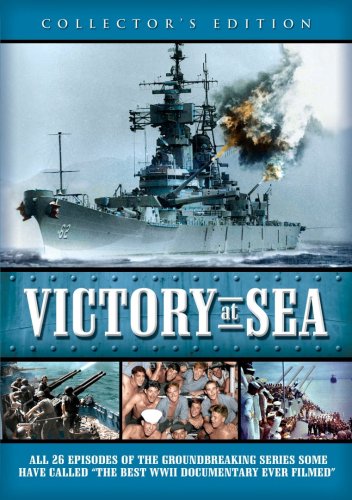
Victory At Sea
(1952)

Run Time: 30 min
Color: Black and White
Aspect Ratio: 1.33 : 1
Sound: Mono
Producer: NBC
Genre
- Action
- Documentary
- War
Seasons: 1
Episodes: 26
Overview
Twenty-six episode series about naval combat during World War Two. Famous for its music score, eloquent narration and combat footage.
Other Related Shows

1.
Design for War
Design for War: Battle of the Atlantic, 1939-1941. World War II begins and the Germans succeed in invading Poland and France. But it is restrained by the British thanks to the vital convoys, Canadian and American naval forces' initial involvement and the Lend-Lease program. Still, the German submarine war increases its crescendo thanks to new French bases.
2.
The Pacific Boils Over
Pearl Harbor, December 7, 1941. Using Japanese footage, viewers see the planning, execution and, ultimately, the celebration of the country's attack on Pearl Harbor. There is also an explanation provided for the attack and some peaceful moments depicted among the U.S. sailors before the fateful events begin. Though badly damaged, the U.S. Navy survives to fight again.
3.
Sealing the Breach
Anti-submarine warfare, 1941-1943. With war now declared by the U.S., naval forces throughout the states have joined to bring convoys of supplies across the Atlantic Ocean to the Allies in England. German U-Boat wolf packs prey on the convoys but they steam valiantly onward despite terrible losses.
4.
Midway Is East
Japanese victories and the Battle of Midway. The Japanese are ascendant as they successfully invade the East Indies, Singapore and the Philippines. But the Americans are victorious, first on the Coral Sea and ultimately on Midway as they manage to bomb and sink four of Japan's aircraft carriers-the same ones that were used for the attack on Pearl Harbor-making the imperial fleet retreat and giving the U.S. an incredible early victory in the Pacific.
5.
Mediterranean Mosaic
Malta, the central access point to various locations in the Mediterranean Sea is a key island possessed by the U.K. but also desired by the Germans and Italians. Malta was therefore subjected to 'round the clock bombing so as to garner it;s capitulation.Malta survives 1774 bombardments. With Gibraltar also being the property of the U.K., every means must be taken to control entry into the Mediterranean Sea.
6.
Guadalcanal
The Imperial Japanese had every intention of expanding its Greater Asia Co-Prosperity sphere of influence and Guadalcanal was necessary for the Japanese's continuing expansion of it. The United States had every intention of obtaining Guadalcanal by wresting it away from them.
7.
Rings Around Rabaul
After the victory at Guadalcanal, Australia and the U.S. next planned to remove the Japanese from Rabaul, New Britain. This involved creating airfields on the surrounding Solomon islands and causing the ultimate defeat of Rabaul by air, sea, and ground.
8.
Mare Nostrum
Benito Mussolini uses 'mare nostrum' which means 'our sea.' Italy's enters into the war with Germany. Britain provides military aid to Greece to help them against the fascists. The German's then storm into Greece. Erwin Rommel and the German's and Italians face Montgomery's British 8th Army repel Rommel in Egypt.
9.
Sea and Sand
The Russians asked the Allies to open a second front to divert some German forces. Operation Torch was then born with Dwight D. Eisenhower as the Commander-in-Chief.
10.
Beneath the Southern Cross
The British Navy engages German U-Boats and the pocket battleship Graf Spee in the South Atlantic. Meanwhile, the United States exerts it's influence to keep the Vichy French from turning vessels in Martinique belonging to the surrendered French government from falling into German hands.
11.
The Magnetic North
The Murmansk Run required the shipping of lend-lease material by convoys to allied Russia. This meant skirting the German occupied territory of Norway replete with air, land, and sea forces and even the weather. On another side, the Japanese and the Aleutian Islands had to be dealt with.
12.
The Conquest of Micronesia
Beginning in August 1943 with more ships of all types available, Admiral Nimitz and Admiral Spruance continue the drive north towards Japan with Japanese resistance along the way beginning with the Gilbert and Marshall Islands.
13.
Melanesian Nightmare
The Japanese crafted Operation Mo to take control of New Guinea and thus ensure the isolation of Australia and New Zealand from the United States in April 1942. The plan was developed by Admiral Isoroku Yamamoto but would ultimately fail.
14.
Roman Renaissance
In Jul 1943, Operation Husky occurred - the amphibious landings at Sicily.which became the start of removing Mussolini's control in Italy.
15.
D-Day
What was involved in the planning, who was to be involved, and when would the planned Operation Overlord (D-Day) invasion actually occur? There were so many contingencies to be considered with weather being one of them.
16.
Killers and the Kill
Highlighting the June 4,1944 capture of the German submarine U-505 and her crew. Captured was 40 crew and her captain. U-505 was towed to Bermuda.
17.
The Turkey Shoot
In June 1944, the U.S. decided to continue releasing islands from Japanese occupation beginning with Guam and the rest of the Mariana islands getting closer to Japan itself.
18.
Two If by Sea
American troops were to free some Japanese held islands before MacArthur could keep his promise to return to the Philippines. One of those islands was Peleliu.
19.
The Battle for Leyte Gulf
The Japanese assembled its entire fleet for a desperation gamble to stop the American advance in the Leyte Gulf while intentionally drawing Halsey's 3rd Fleet off on a feint to the Aleutians.
20.
Return of the Allies
The Battle for the Leyte Gulf was only the first step that had been accomplished so that General MacArthur could indeed say he had returned. There was a struggle taking a long a five months before all of the Philippines was returned.
21.
Full Fathom Five
See the submariners training, relaxation styles, and preparation for warfare. Admiral Lockwood the Commander, Submarines, Pacific Fleet (COMSUBPAC) announced that unrestricted warfare against Japanese merchant and war shipping was authorized.
22.
The Fate of Europe
Visually see European and Russian city warfare sights in 1944 as the Allies free city after city from Nazi Germany's occupation as the war with Nazi Germany comes closer to an end.
23.
Target Suribachi
Before B-29 Flying Fortress' could bomb Japan from airfields on Iwo Jima, it first had to be taken by Marine amphibious landings. After some time, the iconic flag-raising on Mount Suribachi..
24.
The Road to Mandalay
The oil and minerals contained in Burma were the cause of Imperial Japan's occupation beginning with China. Now Lord Louis Mountbatten was chosen to be the Supreme Allied Commander, South East Asia Command.
25.
Suicide for Glory
Suicide missions were desirous of all Japanese who were believers in the 'Divine Wind' philosophy. Suicide was more preferred than was surrendering. These actions on Okinawa had a decisive action on future decisions.
26.
Design for Peace
Hiroshima and Nagasaki and their population experience the atomic bombs ever exploded. Emperor Hirohito tells his people that to prevent further loss of property and life, the war must end.