
- History
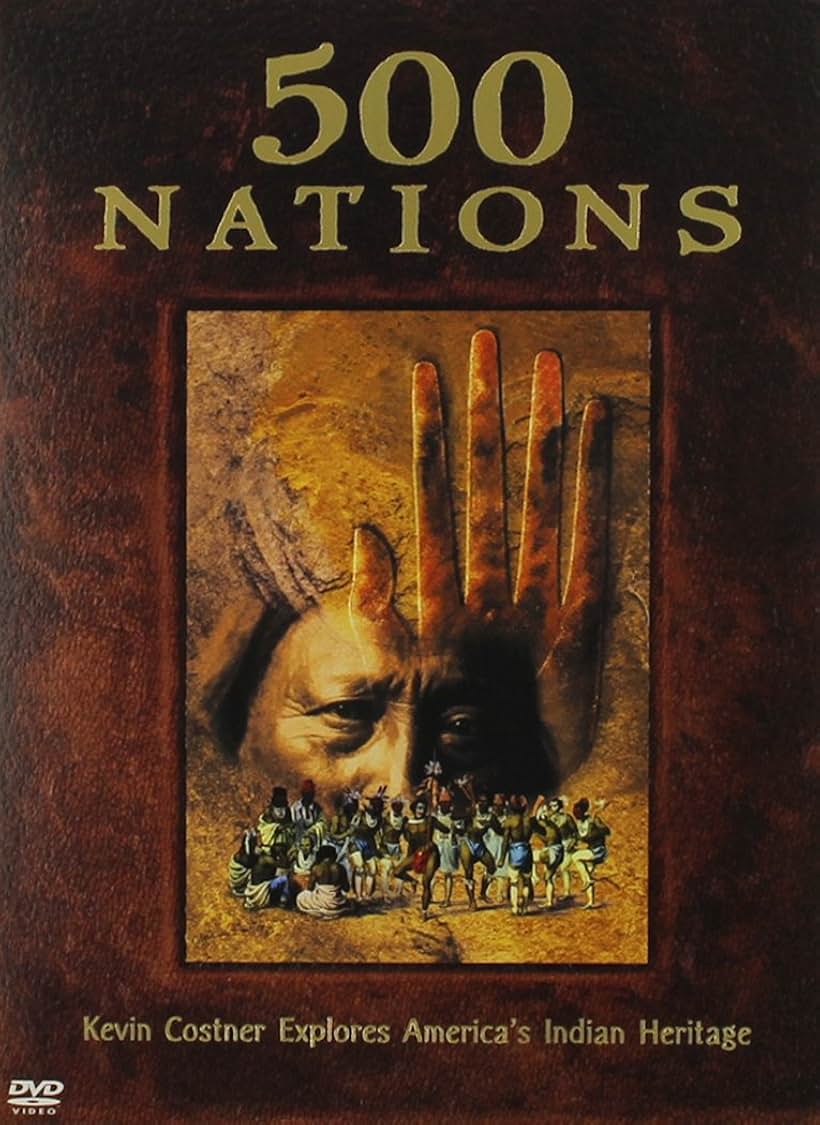
A common misconception is that when European settlers first arrived in America they found only a scattering of "wild Indians," savages whose fame would later rest in the dubious hands of Hollywood filmmakers, where they would invariably be portrayed as the bad guys. The 1995 television miniseries, "500 Nations," goes a long way toward dispelling that myth, pointing out that when the first Europeans reached these shores, there were over 500 Native American nations in North America alone, "tens of millions of people," we're told, the remnants of some of the most-advanced civilizations the world had ever known.*Presented on four DVDs and a bonus CD-ROM, extending to 372 minutes, and introduced by Kevin Costner, "500 Nations" is possibly the most extensive documentary on Native American history and traditions ever made. Like most such documentaries, it has its ups and downs, its moments of poignancy and revelation and its moments of tedium. But every minute of the series is filled with valuable information and insights, and it works well as a continuing and painless education for all of us.*Co-written and directed by Jack Leustig, the series uses a variety of sources--archeological records, journals, paintings, art work, interviews, and CGI reconstructions--to offer a comprehensive look at the natives of North America, not just from the days before Columbus but from the days before Christ. It begins in a past that mirrored the great civilizations of Egypt and continues, mostly chronologically, through the late eighteen hundreds and the massacre at Wounded Knee, which, in fact, is where the story begins. It examines how one of the world's most prominent cultures was reduced to cannon fodder in its darkest hour. It is not a pretty story, and it does not spare either the Europeans or the Native Americans themselves in telling its tale.*The series begins with an introduction by Costner, and he pops up from time to time to continue his commentary. The actual narration, however, is done is by actor Gregory Harrison. Disc one contains segments on Native American creation myths and then chronicles the lives of some of the earliest-known inhabitants of North America: the Anasazi, whose magnificent culture dates back to before 1,000 B.C.; the Maya, from 603-800 A.D.; the warrior Aztecs, by 1500 A.D. one of the most populous nations on earth; the invasion of Mexico in 1519 by Cortez; and the fall of the Aztec civilization through war and smallpox.*The great native empires of North America pretty much ended after the European incursions, but the Native American people continue to live on despite the odds, their stories told here in paintings, carvings, ruins, writings, and computer-graphic representations. There are almost no live-action renderings of the proceedings, however, which means that the material is presented in a fairly academic manner, which may be off-putting to some viewers who might lean toward something more exciting. I have to admit that I couldn't watch more than one disc at a time myself, as the sheer amount of information advanced became somewhat overwhelming, and the pace seemed to slow as my attention span decreased.*Discs two, three, and four follow the same pattern as disc one. Kevin Costner hosts them, Gregory Harrison narrates them, and director Jack Leustig uses maps, still pictures, paintings, location shots, some CGI, and numerous interviews to tell his story. The discs contain two episodes each of the original television series, about an hour-and-a-half per disc, divided into twelve to fourteen chapters.*In addition to Costner and Harrison, the various episodes include voice-overs by Edward James Olmos, Patrick Stewart, Timothy Bottoms, Wes Studi, Amy Madigan, Graham Greene, and others. English is the only spoken language available on the discs, but there are subtitles in English, French, and Spanish.*Disc two, episodes three and four, covers a "Clash of Cultures" and the "Invasion of the Coast." Here we find Col