
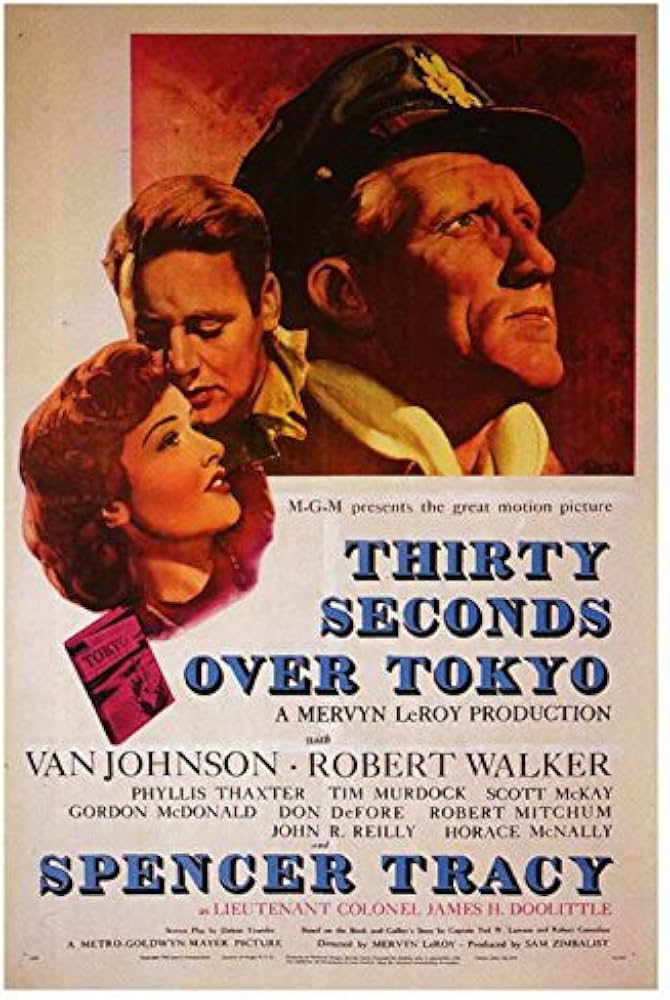
Thirty Seconds Over Tokyo (1944)

The amazingly-detailed true story of "The Doolittle Raid" based on the personal account by Doolittle Raider Ted Lawson. Stunned by Pearl Harbor and a string of defeats, America needed a victory--badly. To that end, Colonel Jimmy Doolittle, a former air racer and stunt pilot, devises a plan for a daring raid on the heart of Japan itself. To do this, he must train army bomber pilots to do something no one ever dreamed possible--launch 16 fully-loaded bombers from an aircraft carrier. Remarkable in its accuracy, this movie even uses film footage from the actual raid.
Heart-Warming Romance . . . Stark, Sensational Drama! Thrills! Action! Adventure! ...Ripped From The Heart!
Lieutenant Colonel James H. Doolittle: [on the phone] Hello, hello, York? Dolittle. I want you to get twenty-four B-25's and volunteer crews down to Eglin Field as soon as you can. The job'll take 'em out of the country for about three months. Tell 'em it's a secret mission. They won't know where they're going until they get there. Thats's right, volunteers. tell them they're not to talk to anybody. That's an order!
Eglin Air Force Base, Fort Walton Beach, Florida, USA
Fort Walton, Florida, USA (Not Fort Walton Beach until 1952)
Oakland, California, USA
Oakland Estuary, Oakland, California, USA
(Clouded by special effects smoke, the giant PG&E natural gas holder can be seen in the film.)
Monterey, California, USA


When Lawson's plane arrives in Tokyo and sees the fire and smoke from the previous bomber, Davy Jones, we are not looking at a special effect. During the making of the film, there was a fuel-oil fire in Oakland, near the filming location. The quick-thinking filmmakers scrambled to fly their camera plane and B-25 through the area, capturing some very real footage for the movie.
The Japanese fishermen fired on by the U.S. Navy escort ships did in fact have time to alert Tokyo, but their transmission was ignored. An urgent report of two American aircraft carriers so close to Japan by understandably hysterical "ignorant" fisherman was scorned as ridiculous by Japanese authorities.
Actual footage of the B-25 Mitchell bombers taking off from the U.S.S. Hornet was used in the film.
The names of the crew of the Ruptured Duck and most of the military men in the film are the actual names of the men who were in this raid.
Twice while the Ruptured Duck is flying over Japan the crew spots Japanese fighter planes and tenses for an attack, but both times the fighters ignore them. This is factual. In an unbelievable coincidence, the Japanese had planned a major air raid drill for the same time in Tokyo, and the fighters thought the American B-25s were part of the drill until the bombs started exploding. Also, according to the book upon which the movie is based the planes' crews were told prior to the mission that there was a slight chance that the Japanese would not recognize them and react because the Japanese air force had a bomber very similar to the B-25.
Continuity
When Lawson's plane lifts off the carrier deck, they immediate raise the landing gear; Several seconds later, when viewed from the side, the gear raises again.
While the Navy is towing the Ruptured Duck to the Hornet, the crew sees a fellow Airman (Spike) standing by the edge of the dock. Spike is standing next to a ladder when the crew first sees him. When the scene shifts perspective, Spike is now standing next to a large ship tie down with a #9 painted on it.
When the Ruptured Duck takes off from the carrier, the front of the engine cowls are dark colored. After the bomb run over Tokyo, an exterior view shows the cowls are white.
After first landing at Eglin Field, from the pilot's seat, Lawson is speaking to another pilot on the ground. In this scene, the propeller blade visible to Lawson's left is almost parallel to the ground and the tip is close to the fuselage. In the next scene from the ground, the propeller blade is at a much higher angle.
As Colonel Doolittle is about to leave the hospital room in DC, he turns around to face Captain Lawson to ask him if his wife is expecting a baby. When he turns, he is holding his hat at waist height. The film then suddenly cuts and Doolittle is shown holding his hat at his side.
Factual errors
The injuries of the crew of the Ruptured Duck are not completely correct. Lawson was hurt the worse, as the movie tries to portray, but in fact his face was pushed in from going through the windscreen of his plane. All of his front teeth were loosened and fell out into his hand when he tried to straighten them. His lower lip was laid open to the cleft in his chin. In addition to his leg being gashed open, his left bicep was severed in half. McClure's injuries were accurately portrayed; both shoulders were broken from hitting the backs of Lawson and Davenports seats. Davenport was shown was being non-ambulatory in the movie and generally helpless; however, other than a bad cut on his forehead (he went through the windscreen too), he was able to move around and help his three more badly injured crew mates. Clever was as badly injured as the movie portrayed him. Thatcher was the least injured, although he had a bleeding bump on his head, which was not shown in the movie. Thatcher received commendation for his efforts to help the three badly-injured crew members.
The map of the training areas in the briefing room bear no resemblance to the actual Eglin Field Proving Ground ranges and prominent Choctawhatchee Bay on the Northwest Florida panhandle. This may have been deliberate as details of the preparation for the Doolittle Raid were still largely secret during the war.
The 3-pointed pinwheel (called a "triskelion") shoulder patches worn by the B-25 crewmen are those of the Air Force Combat Command, a renaming in June 1941 of the former "General Headquarters Air Force" (an air force, not a headquarters) to administer all combat flying units stationed in the continental United States. On February 23, 1942, while the raiders were still in training, the AAF adopted a new "winged star" patch (the "Hap Arnold patch") to replace the pinwheel patch. The raiders arrived in Florida two weeks before the change was adopted. However the new patch should have been worn by the time the raiders flew to Oakland in the film.
Lieutenant Colonel Doolittle was almost bald by the time of the Tokyo Raid, while his portrayer, Spencer Tracy, has a full head of hair.
About 1:02 into the film, as Lawson's crew is being briefed about their target, they are told to head from Tokyo "south by southeast to Yakushima". Yakushima is about 1000 km southwest of Tokyo.
Incorrectly regarded as goofs
Near the end when the U.S. pilots are leaving China, one of them tells the Chinese doctor to come and visit him in Portland "I'm in the Portland phone directory". The pilot didn't say which state he lived in. There are at least 30 cities named Portland in the U.S. The fact is, of course, that everyone is aware of Portland, Oregon whereas only a tiny percentage of people are aware of any other Portland.
Revealing mistakes
When Lawson tries to go to his wife, you can clearly see his "amputated" leg foot and all, flail up behind him as he falls to the ground. He was only sitting on it the entire scene.
Immediately after take-off from the Hornet, Lawson puts the RUPTURED DUCK into a left turn as indicated by the actual horizon outside the windshield. However, the Attitude Indicator (Or Artificial Horizon Gyro Instrument) on the instrument panel shows the aircraft in straight and level flight.
The leather flight jackets worn by most of the flying personnel in the film were close commercial copies of military A-2 flight jackets. Authentic military-contract A-2 jackets had a one-piece back, without a horizontal seam across the shoulders. Most of the jackets in the film have a seam across the back.
Ted Lawson's amputated left leg is briefly visible when he puts the sandal on his right foot.
Miscellaneous
As the Ruptured Duck is making its bomb run over Tokyo The bombs are exploding ahead of the ship and in one instance the plane flies through the smoke of the explosion. Since they are dropped bombs and not rockets all of the explosions would have been directly beneath the aircraft.
None of the planes preceding Lawson retract their landing gear immediately as they should have.
Anachronisms
After their arrival at Alameda, as the pilots are watching the Ruptured Duck being towed toward the Hornet by the "Navy guys", the underside of an aircraft wing is visible behind them. The US national insignia on the wing is the 1944 version, which is different from the insignia used in early 1942 (a red disk within a five-pointed white star on a circular blue field).
Near the end, a Pilot says he's from Pittsburgh, but no true Pittsburgh person would ever pronounce the Monongahela River as "Monongaheeeeela".
About 1:11 into the film, as Doolittle's bomber is preparing to take off, a rounded navigation dome is clearly visible aft of the cockpit. This was introduced in B-25C. The Doolittle Raiders used B-25Bs.
Crew or equipment visible
During the first scene, the shiny surface of the globe bears the reflections of 22 studio lights.
Errors in geography
During the hedgehopping run to Tokyo, barren desert mountains are seen in the background. No such geography exists in Japan, this was filmed in the US Southwest.
When the ladies are at the beach, a mountain can be seen in the background. The land on the gulf coast of Florida is very flat.
About 1:02 into the film, as Lawson's crew is being briefed about their target, they are told to head from Tokyo "south by southeast to Yakushima". Yakushima is about 1000 km southwest of Tokyo.
Character error
There are many instances of military personnel of all ranks wearing hats indoors during WWII. A simple picture search would confirm this fact.
When BG Doolittle was leaving LT Lawson's hospital room near the end of the movie, he began to put on his uniform cap as he was closing the door; however, since he was in the hospital corridor, and not yet going outdoors, he would not have put on his cap while indoors.