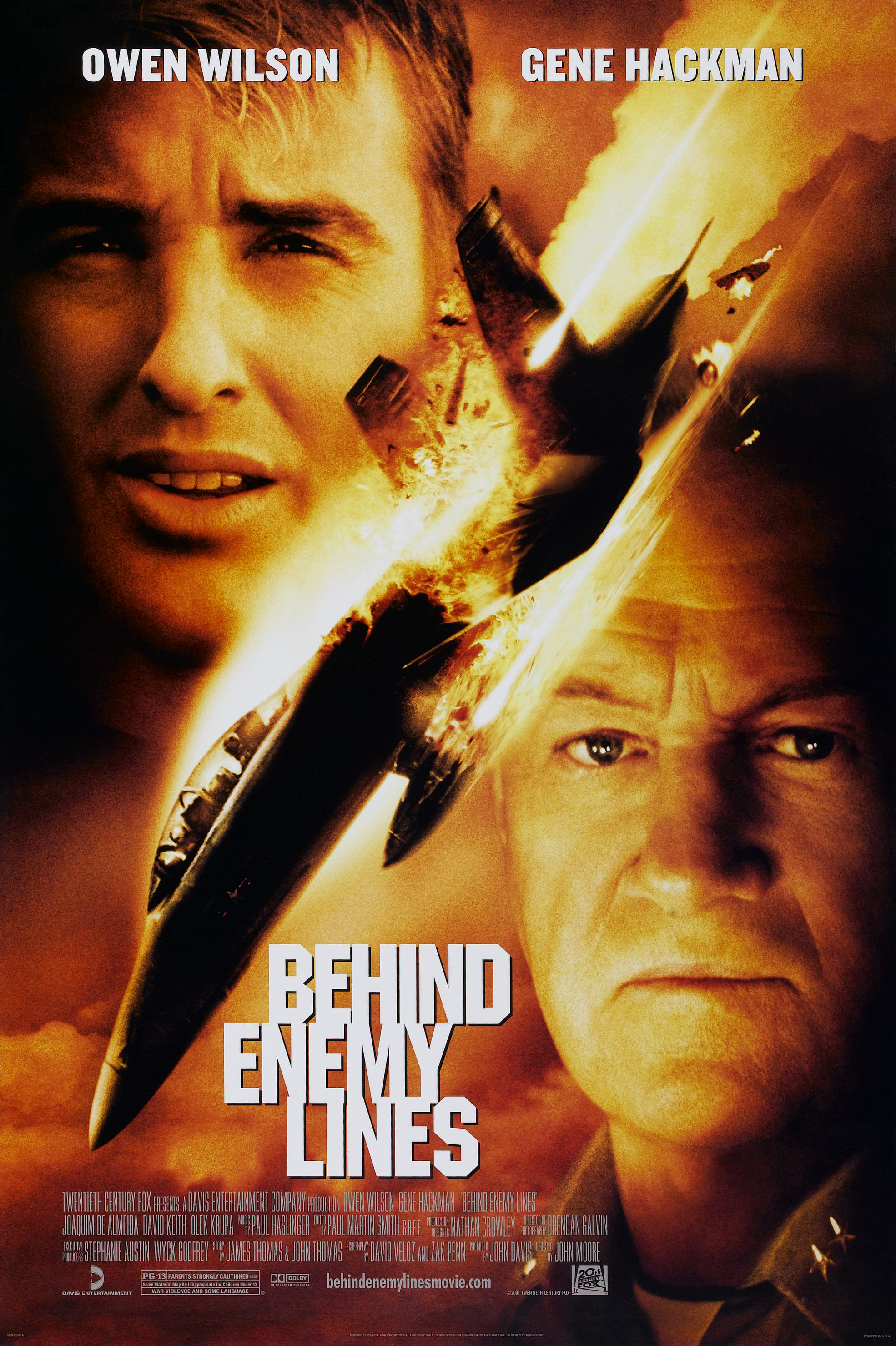
Behind Enemy Lines (2001)

Fighter navigator Chris Burnett wants out: he was looking for something more than the boring recon missions he's been flying. He finds himself flying the lone Christmas day mission over war-torn Bosnia. But when he talks pilot Stackhouse into flying slightly off-course to check out an interesting target, the two get shot down. Burnett is soon alone, trying to outrun a pursuing army, while commanding officer Reigert finds his rescue operation hamstrung by politics, forcing Burnett to run far out of his way.
In War There Are Some Lines You Should Never Cross.
Capt. Rodway, USMC: We each have our jobs. Now I'm a Marine. That means I do the serious work. You're a Navy Pilot. That means that you sit here and... eat jello.
Slovakia
USS Carl Vinson, Pacific Ocean
USS Constellation, Pacific Ocean
Koliba Studios, Bratislava, Slovakia
(Studio)
Van Nuys, California, USA
Director John Moore was nearly killed while operating the camera for the shot where the tank busts through the wall. He was pulled out of the way by stuntman Jimmy N. Roberts just in time. This take was used in the movie, and Moore's being pulled back is why the shot suddenly shakes.
Owen Wilson separated his shoulder doing stunt work on the movie. He was back the next day shooting action sequences.
The film is based loosely on the experiences of U.S. Air Force Captain Scott O'Grady, who was shot down over Bosnia in June 1995, and was stranded in Serb-held territory for six days before being rescued by U.S. Marines. O'Grady brought a lawsuit against Twentieth Century Fox for damages to his character. He claims he didn't curse as much and never disobeyed orders. The suit was eventually settled out of court.
None of the actors playing Serbians were actually Serbian; the producers said that they hired Croats as interns and instructors to teach the actors the Serbian language (which is virtually identical to Croatian), because they couldn't find any Serbs willing to work on the film due to perceived anti-Serb sentiment shown in the film. Vladimir Mashkov, who played the Serbian sniper Sasha, is Russian, and Olek Krupa, who played the Serbian General Miroslav Lokar, is Polish. Some Slovaks also participated in the film, such as Marko Igonda, who played Colonel Bazda, and Kamil Kollarik, who played a guerrilla who aids Burnett in Hac.
Owen Wilson jokes that most of this movie was creating "a bunch of ways to make running dramatic."
Continuity
After the missile hits the jet, Burnett is the first to eject. When Stackhouse is ejecting, he is seen struggling to do so as the front part of the jet he is in is swinging around to the ground at high speed, yet after he manages to eject he is seen descending to the ground next to Burnett. Given the amount of time in between Burnett's and Stackhouse's ejection, the two would have certainly been a long way apart while descending to the ground.
Burnett is sent to a rendezvous point for evacuation. He radios in when he reaches it and informs Reigart of this fact. However, when the radio contact goes down, Reigart orders his staff to "find out where he is" and triangulate his position, even though they know where he is: at the rendezvous point they told him to go to.
In the scene when Burnett is walking through the mine field between the buildings, he is hit by several mine blasts at fairly close range. The first blast killed the enemy soldier at nearly the same range and with only one blast.
When Burnett first spots activity on his screen, the plane is a few thousand feet above the ground. Yet on his scope screen it says they are over 20,000 feet up.
Just before Chris Burnett gets on the helicopter, he has blood stains on his face. On the chopper, the blood is gone. When he gets off the chopper onto the carrier deck, the blood is back.
Factual errors
No missile in existence would be capable of chasing the F/A-18 as it is portrayed in the film. A missiles rocket motor only holds enough fuel for one pass at a target. The second missile fired in the film flies through a fireball, completes a loop, and continues to chase the F/A-18 the way a dog chases a cat. In reality, the missile would have either exploded the first time it got close to the fighter, or simply ran out of fuel.
Neither the Squadron Commander--Burnett's actual CO and not Reigert--or the ship's CO (Admiral Reigert) would need permission from NATO (Admiral Piquet) to rescue one of their own pilots regardless of any so-called "peace" negotiations and would not in any way be a prelude to war or disruption of those negotiations.
In the beginning Burnett uses a "shuttle kick" to kick a football. Even though the pressure can be adjusted a shuttle kick would destroy a football as opposed to launching it into the air (which is exactly what happened when they attempted it during filming).
During the ejection sequence, the two seats collide with each other. Ejection seat systems are designed so that the seats will direct themselves away from one another to prevent this.
During the ejection sequence, Stackhouse is not ejected after Burnett. The ejection sequence automatically ejects both pilots and he would not need to pull the handle again to eject, nor to deploy the parachute. Also he has his arms outstretched beyond the cockpit which would make them flail in the extreme wind. This is not proper ejection posture, as he should keep his hands on the handle to prevent injury.
Incorrectly regarded as goofs
Master Chief Tom O'Malley is wearing the wrong surface warfare insignia on his uniform. As a senior enlisted man he should be wearing an enlisted surface warfare specialist pin which is silver, not the gold surface warfare officer insignia.
Revealing mistakes
At the statue, when Sasha is scanning the area through his rifle scope, the camera shows him through the other end of the scope and his eye is magnified. In reality the opposite would happen, making his eye appear smaller.
At minute 40: Serbian soldiers are chasing Burnett. They come from right to left. All of them appear to be left handed and all the guns have ejection ports on the left side showing that the whole scene has been inverted.
After ejecting from the aircraft, both pilots are seen floating down past the statue on Ram type parachutes. When Burnett hits the trees and the camera is looking up at him coming down through the branches, he is under a round parachute.
When Burnett is running through the forest and being fired upon for the first time the bark on the trees around him is exploding as though the bullets are being fired from the direction he is running and not from behind him. The tracer bullets also appear to be coming from the direction he is running.
Some of the machine guns on the backs of the Serbian jeeps have no ammo boxes, but still fire.
Miscellaneous
At the beginning of the movie where Burnett and Stackhouse is scrambling, the movie clearly shows that their aircraft number is 106 of VFA-163. As the movie goes to the scene that the F/A-18 is aligning to the catapult, there is a blurred take that the aircraft number is 211.
Anachronisms
When the football is lost over the side of the aircraft carrier, Chris yells "Wilson!". The movie takes place in 1995, and this is a reference to the movie "Cast Away", which wasn't released until 2000.
The boy in the truck sings Puff Daddy's song "Public Enemy 2000", which was released in 1999.
The movie is set in 1995, but a pilot mentions John Denver's death which was on 12 October 1997.
The F/A-18-E/F Super Hornets didn't begin sea trials until January 1997 onboard the USS John C. Stennis (CVN 74).
At the beginning of movie, Stackhouse and Burnett are talking and one of them mentions Britney Spears. She was relatively unknown until 1998, three years after the events of this film took place.
Audio/visual unsynchronized
In the scene where Burnett sets up a trap for the Tracker, Burnett is running towards him while firing his pistol. During this sequence the ejection of a spent casing can be seen (as well as the slide moving to the rear to eject) but there is no gunshot. The gunshot and subsequent muzzle flash happens noticeably after.
Crew or equipment visible
In some of the overhead shots of the jets, studio lights are reflected on the cockpit glass.
After Burnett stabs Tracker with the flare, you can see the square-shaped device which is really producing the flame effect bulging under his jacket as he is lying on the ground.
Errors in geography
Throughout the movie, Reigart and the media claim Burnett and Stackhouse were shot down over southern Bosnia even though they were shot down in the Srebrenica region, which is the easternmost point in Bosnia.
When Burnett sits in the back of the pick-up truck you can see yellow road marking lines. In Bosnia, where the story takes place, these lines are white, not yellow.
When Burnett fell in the mass grave, after Serbian soldiers retreat, the Serbs have memory flashes about the killing of civilians. There is a Croatian badge on one of the Serbian soldiers. (Stock footage from Savior (1998) is involved.)
Plot holes
The argument between the NATO fleet commander Piquet and Commander Reigart would not have taken place. NATO works very closely and very discreetly with American ship captains in any possible conflicts, and thus Piquet would have, in reality, supported any plan of Reigart's to get his downed pilot back, and none of it would involve the media, since specific ship and aircraft positions, maneuvers and operations are highly classified and thus would have remained top secret.
Given the mountainous terrain and the deep woods, it is very unrealistic that Sasha and the rest of the Serb army could continually follow Burnett as he's evading them because all a person has to do to lose somebody in such deep woods is to veer right or veer left and, given the distance that originally separated Burnett from the Serbs, they would've had no idea what way he was specifically traveling.
Character error
Burnett, while on the run, drank his last sip of fluid from the plastic bottle and tossed it onto the ground. That would never had happened in real life. He would have buried it so as not to be easily tracked.
In the final battle, the Admiral tells the Captain to fast rope to retrieve Burnett. Fast roping is a rapid insertion technique where a soldier has no attachment to the rope. He is simply sliding down it all the way to the ground.
Burnett moves to the top of a mountainous ridge, in order to get better reception to communicate with his carrier. In doing so, he skylines himself at the top, i.e., he allows his silhouette to be visible above the ridge, making it easy for him to be seen from the surrounding countryside. As hostile forces are actively searching for him, it is highly unlikely that he would have forgotten his training and pulled such a bonehead move.
The Admiral's two-star collar insignia should be worn nearer the points of each collar, and perpendicular to a line bisecting each collar point.
When Adm Reigart is discussing the situation with Adm Piquet he says to Adm Piquet about a reporter being on his "Boat" a Carrier is always called a "Ship" not a boat.