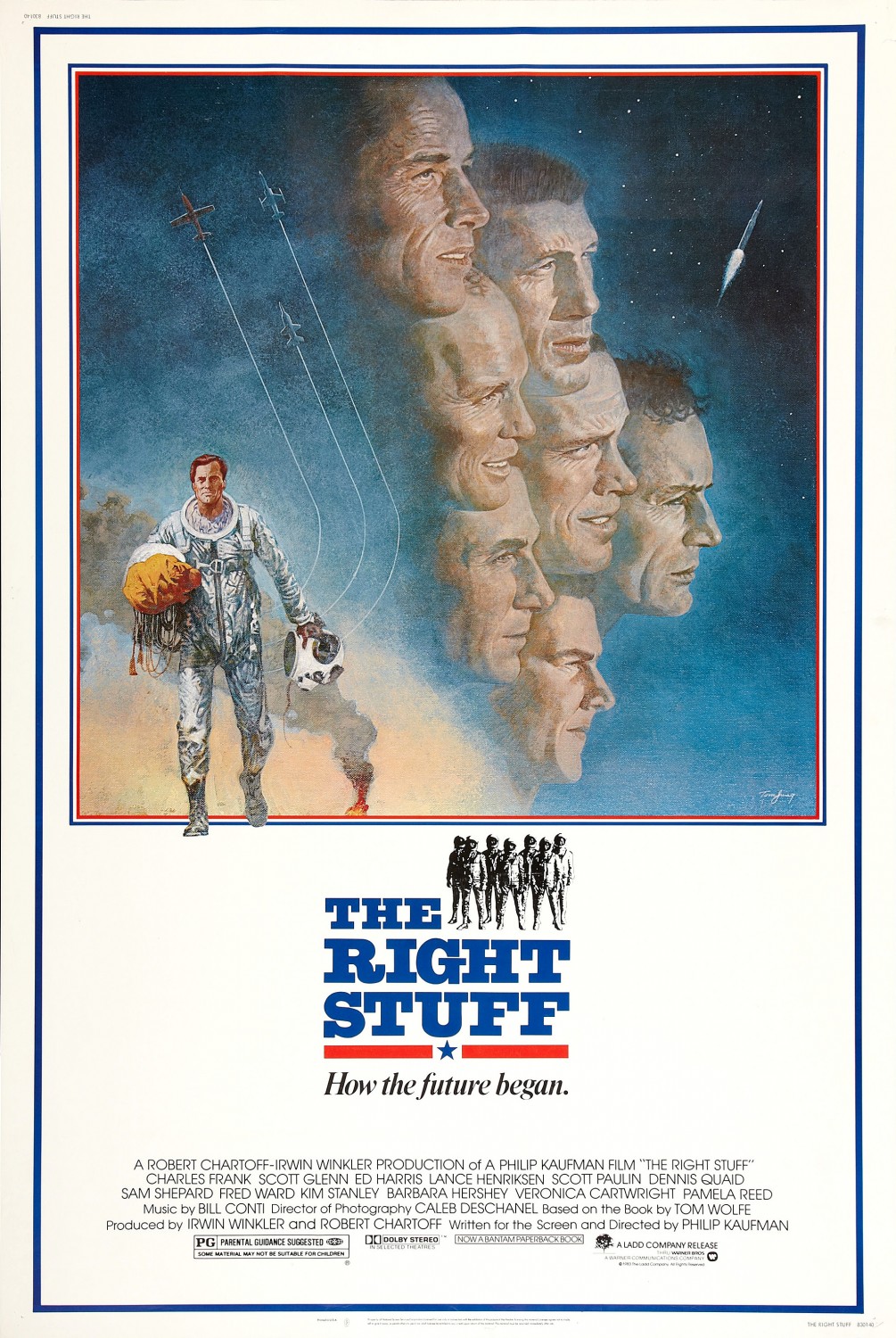
The Right Stuff (1984)

Tom Wolfe's book on the history of the U.S. Space program reads like a novel, and the film has that same fictional quality. It covers the breaking of the sound barrier by Chuck Yeager to the Mercury 7 astronauts, showing that no one had a clue how to run a space program or how to select people to be in it. Thrilling, funny, charming and electrifying all at once.
By flying higher and faster than any other man had ever dared before, Chuck Yeager set the pace for a new breed of hero. Those that had just one thing in common...THE RIGHT STUFF.
Narrator: There was a demon that lived in the air. They said whoever challenged him would die. Their controls would freeze up, their planes would buffet wildly, and they would disintegrate. The demon lived at Mach 1 on the meter, seven hundred and fifty miles an hour, where the air could no longer move out of the way. He lived behind a barrier through which they said no man could ever pass. They called it the sound barrier.
California & Montgomery, Financial District, San Francisco, California, USA
Cow Palace, San Francisco, California, USA
Edwards Air Force Base, California, USA
Half Moon Bay, California, USA
(capsule splashdown)
Hamilton Air Force Base, Novato, California, USA
Mojave Desert, California, USA
San Francisco, California, USA
USS Coral Sea

According to NASA, the mysterious "fireflies" observed by John Glenn on his first orbital flight were actually condensed ice crystals from the small hydrogen peroxide rockets used for altitude control illuminated by sunlight. Upon uses many of them formed a particulate cloud around the spacecraft and many attached themselves to the skin of the vehicle as well. This was confirmed by astronaut Scott Carpenter on the next Mercury flight when he banged on the craft's side, causing more of the flakes to break free and become visible.
It is generally believed that Gus Grissom was not at fault in the real-life hatch-blowing incident on the Liberty Bell 7 capsule. Kickback from the manual activation switch caused a tell-tale bruise to form on the hand activating it, and Grissom never developed the bruise. Wally Schirra, at the end of his Mercury 8 space flight, deliberately activated his own hatch to demonstrate how the bruise formed and exonerate his comrade. The most likely explanation for Grissom's hatch blowing is that the external release lanyard came loose as it was only held in place with a single screw - a design that was changed to be more secure for subsequent flights. N.A.S.A. apparently believed in Grissom's innocence as well, as he remained in a prime rotation spot for subsequent Gemini and Apollo flights. There is also significant belief among astronauts of the time that, had he not been killed in the Apollo 1 fire, Grissom would have been the first man to walk on the moon.
While several of the lead actors chose to meet their real-life counterparts, Scott Glenn elected not to meet with Alan Shepard. Scott said he wanted to get down Shepard's character and nuances by observation and by hearing others' points of view. After filming, the real Alan Shepard wrote writer and director Philip Kaufman and commented on Scott Glenn's "spot-on" performance - except for "not being nearly as good-looking as he was."
In the film, Alan Shepard says "Louise, I'm going to the moon, I swear to God. I'm on my way." Of the Mercury Seven, Shepard was the only one that did go there, on Apollo 14, becoming the fifth person to walk on the moon (and the only person to ever play golf on the moon) on February 5-6, 1971.
Upon his death on December 7 2020 (the 79th anniversary of the Japanese attack on Pearl Harbor), Chuck Yeager was the last surviving real character.
Continuity
When Yeager is setting the speed record at Mach 2.5, close shots show his aircraft cutting through bank after bank of clouds; yet shots from the ground show him streaking through a clear sky.
When the footage of Glenn's launch is shown, the footage from the rocket looking down at the ground is actually from a Little Joe rocket launch at Wallops Island, Virginia. A characteristic orange painted tip of the stabilizing fin is visible, as well as ground installations, all of which are still in use today.
When Alan Shepard is shown receiving the NASA Medal from President Kennedy at the White House, the first shot shows him already wearing the medal before Kennedy presents it to him.
When Shepard is landing on the aircraft carrier, the view from his POV shows a level approach, but when the camera cuts to Shepard himself, it can be seen by the ocean outside that the aircraft is in a steep turn.
Commenting on the launch and recovery of Ham the chimpanzee, Chuck Yeager is seen wearing his flight suit with the insignia of a Colonel (eagles). Immediately subsequent to this, Yeager is seen at a party at his home where he wanders outside to look up at the moon; on the collar of his class B uniform is the insignia of a Major (gold oak leaf).
Factual errors
During the second funeral sequence, Gordo Cooper is wearing decorations on his service dress uniform denoting service in the Korean War. In reality, Cooper was the only member of the "Original Seven" who was not a combat veteran.
In the press conference scene introducing the Mercury astronauts, the astronauts all raise their hands (Glenn raises both hands) to the question "Which one of you will be the first into space"? In reality, the question raised was whether they were confident they would return from space.
There were no fatal accidents with the Bell X-1 before Chuck Yeager broke the sound barrier.
The Air Force did not ask Chuck Yeager on October 13, 1947, to break the sound barrier the next day. He had been flying the Bell X-1 (which he had named the "Glamorous Glennis") since August and had made 8 previous powered flights. When he actually broke the sound barrier on October 14, it was by accident. The target speed was Mach .97, but at speeds just under Mach 1, a shock wave made the Machmeter read low.
The separation of Alan Shepard's Mercury capsule and his Redstone rocket is actually footage of an Atlas first stage dropping away from the main stage. The main stage of the Atlas went on with one engine, the center engine. The Redstone was one stage only.
Incorrectly regarded as goofs
When Chuck Yeager makes the first supersonic flight, the plane's Machmeter is shown going off scale because it only reads up to Mach 1. Although this seems completely silly because the plane was always intended to fly supersonically, it is in fact what happened.
Yeager's NF-104 flight was portrayed as an unplanned, spur of the moment thing. Both his autobiography and the book this movie is based on imply that the flight was well-planned, and the control tower would have known about it. This is a clear case of artistic license.
When told that he must keep the news of the breaking of the sound barrier from the Russians, a reporter wonders why that is necessary, especially since Russia is an ally of the United States. By October 1947 events in Eastern Europe (Soviet-backed government take-overs by Communists in Poland, Romania, Bulgaria, Yugoslavia, Hungary, and Albania) and agitation in Czechoslovakia and Berlin had made it apparent to all except the naivest that Russia was no longer America's ally. However, the implication of the scene is that the reporter is indeed extremely naive.
Jack Ridley died in 1957, hence would not be around in 1961 to talk to Yeager about Grissom's flight or in 1963 to talk to Yeager about the upcoming NF-104 flight. This is a clear instance of dramatic license.
Near the beginning, after Slick Goodlin demands $150k to try to break the sound barrier, the group that asked him approaches Yeager to see if he will do it. They get his attention by calling "Major" to him, but Yeager is wearing a Captain's insignia. When the officer approaches the table at which Jack Ridley, Chuck Yeager, and two women are sitting, it is actually Ridley that properly addresses the officer as Major. The officer then says, "Say there, Yeager" to get Yeager's attention, to which Yeager replies, "Sir."
Revealing mistakes
According to the serial number seen on the canopy of Yeager's F-104, that particular aircraft was built as a G model, in Germany by Fokker Aircraft, for the Luftwaffe in 1963. It flew in USAF colors at Luke Air Force Base (near Glendale, Arizona) from 1964-1966. (Interestingly, this exact same aircraft was totally destroyed in a crash 5 miles west of Aguila, Arizona on 3 March 1966. The German pilot successfully bailed out.)
Toward the end when Chuck Yeager ejects from the NF-104, the Cessna that carried the stunt man can be seen in the upper part of the screen.
Yeager talks to Ridley, just before taking up the NF-104A. Ridley is wearing sunglasses that reflect the hangar entrance where Yeager should be standing, but isn't. There is however a crew member holding up a light visible in the reflection.
During Chuck Yeager's 1953 attempt at Mach 2 in the silver Bell X-1A, the wire suspending the model is visible just behind the cockpit canopy.
During some of the flight sequences, the view through the cockpit windows is clearly back projection. There are little specks of dirt on the skyline.
Anachronisms
When the footage of Gagarin in space is shown, the soundtrack is of another Russian cosmonaut, Alexei Leonov, saying that the Soyuz spacecraft is ready for the merging with Apollo (which took place in 1975).
The call sign of the X-1 that crashes before Yeager's flight is "Whiskey Kilo Two." "Whiskey" and "Kilo" represent W and K in the NATO Phonetic Alphabet, which the U.S. Armed Forces adopted in 1956. Yeager's flight took place in 1947, when the armed forces used the Joint Army-Navy Phonetic Alphabet, in which "William" and "King" represent W and K. The call sign "Whiskey Kilo Two" derives from a rhetorical passage in Tom Wolfe's book which does not refer to a specific time period.
When Alan Shepard walks between the cheering crowd upon landing on the aircraft carrier, some sailors have beards, something the Navy allowed for a few years in the 1970s and early-'80s (when the film was being shot) but unheard of in the early-'60s.
Among the pictures on the wall in Pancho's in 1947 is a pilot standing by later-model X-1 (or possibly an X-2, the whole aircraft is not shown) painted white and with the Bell Aircraft logo. The X-1 in 1947 was not painted white nor did it have the Bell logo. The photo obviously was taken several years later. Also, Pancho's Club appeared in several subsequent scenes after it actually burned in November 1953, namely 1956 when Gordon Cooper first arrived at Edwards (not 1953 as the movie states), 1957 at the time of Sputnik, and at the time of Grissom's flight in 1962.
When Yeager is taxiing the NF-104 out for the flight that ended in his flat spin and crash, the control tower operator cannot identify the aircraft type, despite the fact that the F-104 had been first flown at Edwards AFB in 1954, and had been in Air Force service since 1958. It was commonly used as a chase plane for test flights by December 10, 1963, and were also used at Edwards for high speed chase planes from mid-1963 on. It is highly improbable that any control tower personnel would have been unfamiliar with the type.
Audio/visual unsynchronized
When Yeager stalls the NF-104, "engine restart" sounds are heard before he actually moves the toggle switches.
Errors in geography
After the awards ceremony, the Grissoms return to their motel on the beach in Florida. Certainly this is near Cape Canaveral on the East Coast. But when the newsmen swarm outside their window, the sun is rising just above the ocean horizon behind them. On the east coast, this would mean it's just now dawn.
Character error
At the press conference, astronaut Scott Carpenter, whose first name is Malcolm, has his nameplate misspelled as 'Malcom'.
The astronauts insist that the capsules are referred to as "space craft"; later, when John Glenn is in orbit, he refers to it as a capsule.
When Glenn is orbiting, a NASA employee is shown moving a Friendship 7 model on a display indicating its position in its orbit. When Glenn passes into night, he's talking to Cooper at NASA's relay station in Australia, yet the technician moves the model to the North Atlantic near the Azores, where he wouldn't be able to be in direct communication with Australia.