The Passion Of The Christ (2004)

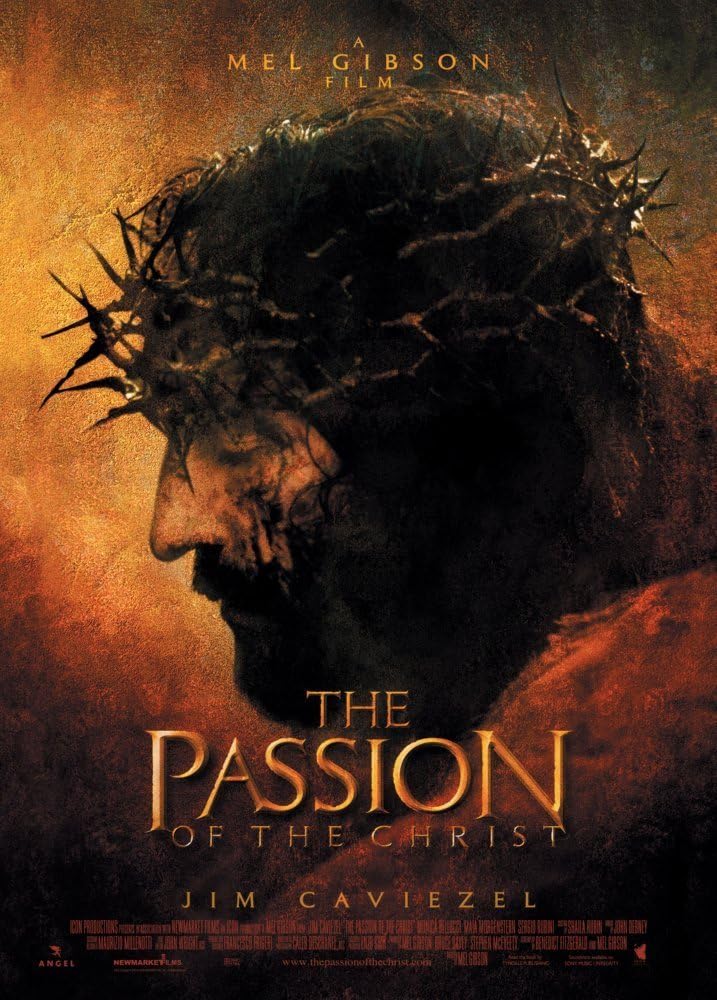
A depiction of the last twelve hours in the life of Jesus of Nazareth, on the day of his crucifixion in Jerusalem. The story opens in the Garden of Olives where Jesus has gone to pray after the Last Supper. Betrayed by Judas Iscariot, the controversial Jesus--who has performed 'miracles' and has publicly announced that he is 'the Son of God'--is arrested and taken back within the city walls of Jerusalem. There, the leaders of the Pharisees confront him with accusations of blasphemy; subsequently, his trial results with the leaders condemning him to his death. Jesus is brought before Pontius Pilate, the prefect of the Roman province of Judaea, for his sentencing. Pilate listens to the accusations leveled at Jesus by the Pharisees. Realizing that his own decision will cause him to become embroiled in a political conflict, Pilate defers to King Herod in deciding the matter of how to persecute Jesus. However, Herod returns Jesus to Pilate who, in turn, gives the crowd a choice between which prisoner they would rather to see set free--Jesus, or Barrabas. The crowd chooses to have Barrabas set free. Thus, Jesus is handed over to the Roman soldiers and is brutally flagellated. Bloody and unrecognizable, he is brought back before Pilate who, once again, presents him to the thirsty crowd--assuming they will see that Jesus has been punished enough. The crowd, however, is not satisfied. Thus, Pilate washes his hands of the entire dilemma, ordering his men to do as the crowd wishes. Whipped and weakened, Jesus is presented with the cross and is ordered to carry it through the streets of Jerusalem, all the way up to Golgotha. There, more corporal cruelty takes place as Jesus is nailed to the cross--suffering, he hangs there, left to die. Initially, in his dazed suffering, Jesus is alarmed that he has been abandoned by God his father. He then beseeches God. At the moment of his death, nature itself over-turns.
By his wounds, we were healed.
Title card: He was wounded for our transgressions, crushed for our iniquities; by His wounds we are healed. Isaiah 53; 700 B.C.
Craco, Matera, Basilicata, Italy
Cinecitt? Studios, Cinecitt?, Rome, Lazio, Italy
(Studio)
Jim Caviezel experienced a shoulder separation when the 150lb cross dropped on his shoulder. The scene is still in the movie.
In interviews with Newsweek magazine and several other media, Jim Caviezel spoke about the difficulties he experienced while filming. This included being accidentally whipped twice, which has left a 14-inch scar on his back, and dislocating his shoulder from the weight of the cross. Caviezel also admitted he was struck by lightning while filming the Sermon on the Mount and during the crucifixion. His hair actually caught fire from this, but he was otherwise miraculously unharmed. (In 2023 the actor revealed that he was taken to hospital and actually died for a few minutes. This made him feel even closer to god when he was revived) The scenes of him hanging on the cross in the dead of Italian winter (with temperatures of 25?F/-4?C and 30-knot winds) caused him to contract hypothermia and pneumonia. Finally, because make-up was used to create a swollen eye, his lack of depth perception gave him migraine headaches.
This is the highest-grossing foreign language film or subtitled film in U.S. box office history. It is also the highest-grossing religious film in the worldwide box office.
It would usually take over 10 hours to put Jim Caviezel into the scourged makeup. On some of those days, it would happen that the weather conditions turned out to be unsuitable for filming. To avoid spending more hours to have it removed and re-applied the next day, he kept it on and went to bed in full make-up.
Mel Gibson had a Canadian priest, Fr. Stephen Somerville, celebrate the Traditional Roman Catholic Latin Mass of the Apostolic Rite for the film crew each day before production began.
Mel Gibson: Gibson's hands nail Christ to the cross during the Crucifixion scene. Gibson said "It was me that put him on the cross. It was my sins" that put him there. According to special edition commentaries, Gibson also supplied the foot of Jesus (washed by Mary Magdalene) and the arms that tie Judas' suicide rope. His crying, screaming voice is heard during the latter scene.
Continuity
In the flashback scene where Jesus kneels to draw a line in the sand, he reaches across with his right hand. The hand that actually draws the line is a left hand, with the palm facing away.
During the first half of the scourge scene, Jesus' hands are dark and bloodied by his shackles. Then a dramatic close-up shows them nearly clean.
The lead Roman soldier's teeth are yellow during the flogging scenes, white and perfect along the route to Golgotha as Jesus is carries the cross, and yellow again during the crucifixion scene.
As Jesus carries his cross, the blood on the cross disappears and reappears between shots.
A shawl appears on Mary Magdalene's head between shots after Jesus, on the cross, says, "Son behold your mother...".
Factual errors
Latin and Aramaic are spoken throughout, but Greek is not spoken or used at all. Greek was the common language of the eastern Roman Empire. The accusation on the Cross of "Jesus of Nazareth, King of the Jews" was written in Greek as well as Aramaic and Latin; the sign is shown, but no Greek.
When Mary cleans the tiles of her son's blood splatters, the blood is still liquid. It would have coagulated and then dried in the heat.
Incorrectly regarded as goofs
Differences with the written source material are not counted as goofs, especially when they're caused by dramatic decisions. Historical inaccuracies are similarly exempt, especially when caused by reliance on religious and artistic traditions.
Silk road traders from Mongolia and China used domestic Bactrian (two-humped) camels. It's unlikely, but not impossible, that they would turn up in the Middle East, the Silk Road's western terminus.
Just after Jesus' appearance in front of Herod, Pontius Pilate claims he had put down rebellions in Judea for eleven years. Pilate was prefect (not procurator) of Judea from 26 CE to 36 or 37 CE, and had been so for only seven years when he met Jesus. But not much about Pilate is known, and he could have been in Judea in another position before that time.
Revealing mistakes
Satan moves through the crowd while Jesus is being beaten. Jesus is the only one who is supposed to be able to see Satan. However, one man in the crowd follows Satan with his eyes as Satan moves past him.
Jesus' computer-generated brown eyes sometimes fade into Jim Caviezel's blue ones. This happens when Jesus is taken at Gethsemane, and again after Jesus has first taken the cross on his shoulders (before the shot with the donkeys and palm leaves in the background).
Flipped shot: Jesus stumbles and falls to the ground while carrying the cross, his injuries are to his left eye for one shot. By the next shot the injuries have returned to his right eye.
Before Judas commits suicide he puts his hands to his face. The makeup on his right hand is peeling away.
Jesus' arm is dislocated to make his hand reach the nail hole, so his arms should be fully extended and straight at all times. However, in almost all shots of him on the cross, his body sags forward with his arms bent at an almost 90 degree angle.
Anachronisms
Throughout the movie, characters speak Syrian Aramaic, which was used in the 7th and 8th centuries CE, not the 1st century CE Palestinian Aramaic they would have used.
Boom mic visible
When Mary goes to clean the blood, as the camera pans over the bloody cobbles, the boom is reflected in the largest pool of blood.
Character error
When Jesus is being whipped, one soldier counts the lashes in Latin. He pronounces 18 and 19 correctly, but mispronounces 28 and 29. He is supposed to say 'duodetriginta' (28) and 'undetriginta' (29) but he says 'vigintiocto'.
While Pontius and his soldiers speak Latin, you can hear wrong pronunciations. They tend to say 'fachere', 'dichere', 'fachit' while they are supposed to say 'fatsere', 'ditsere', 'fatsit' or 'fakere', 'dikere', 'fakit'.