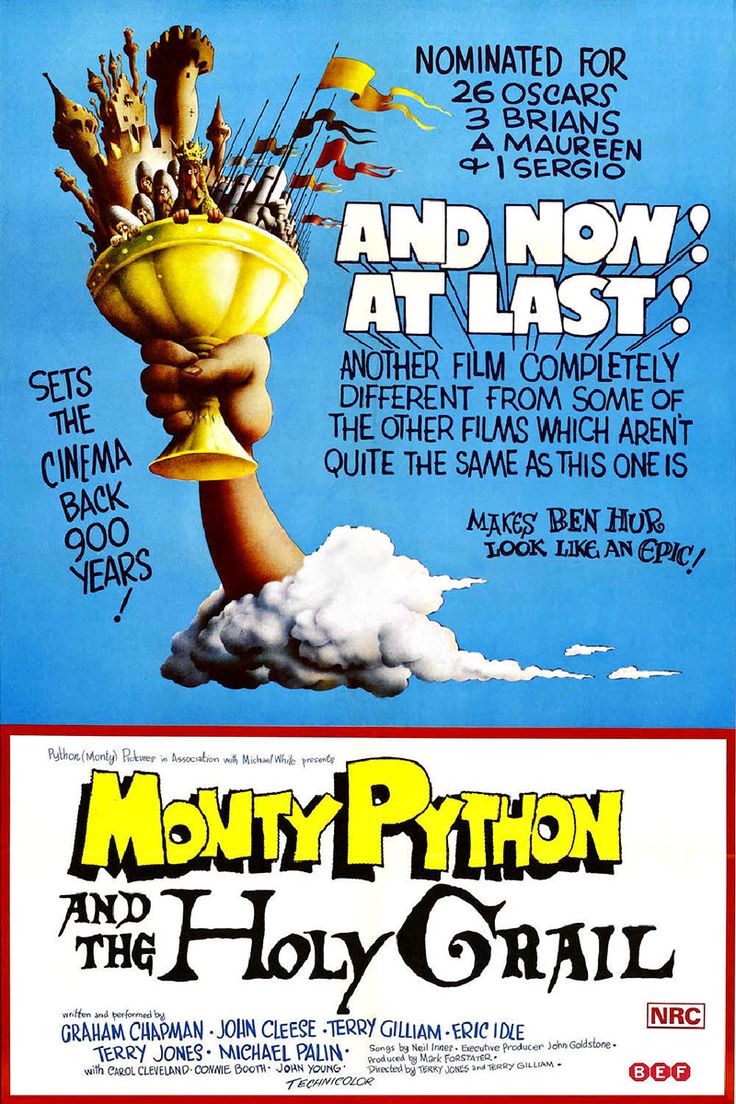
Monty Pythons And The Holy Grail (1975)

History is turned on its comic head when, in tenth-century England, King Arthur travels the countryside to find knights who will join him at the Round Table in Camelot. Gathering up the men is a tale in itself but after a bit of a party at Camelot, many decide to leave only to be stopped by God, who sends them on a quest: to find the Holy Grail. After a series of individual adventures, the knights are reunited but must face a wizard named Tim the Enchanter, killer rabbits and lessons in the use of holy hand grenades. Their quest comes to an end however when the Police intervene - just what you would expect in a Monty Python movie. ?garykmcd
You can do worse than see it.
French Soldier: I don't want to talk to you no more, you empty-headed animal food trough wiper! I fart in your general direction! Your mother was a hamster and your father smelt of elderberries!
Castle Stalker, Appin, Argyll and Bute, Scotland, UK
(Castle of Aaaargh)
Bodiam Castle, Bodiam, East Sussex, England, UK
(single exterior shot of the Swamp King castle during "Tale of Sir Lancelot")
Doune Castle, Doune, Stirling, Scotland, UK
(Arthur begins his quest for the Holy Grail)
Glen Coe, Highland, Scotland, UK
(Bridge of Death)
Epping Forest, Essex, England, UK
(Black Knight sequence)

Led Zeppelin, Pink Floyd, and Genesis all contributed to this movie's budget.
Funds earned by Pink Floyd's album "The Dark Side of the Moon" went towards funding this movie. The band were such fans of the show, they would halt recording sessions just to watch Monty Python's Flying Circus (1969).
The famous depiction of galloping horses by using coconut shells (a traditional radio-show sound effect) came about from the purely practical reason that the production simply could not afford real horses.
When this movie screened at the Cannes Film Festival, the audience laughed at the opening credits. However, the projector stopped and the audience just roared with laughter, thinking it was all part of this movie. It turned out there was a bomb scare, and firemen came in and made everyone in the cinema go outside.
During one of the first screenings of this movie in front of a live audience, co-writer and co-director Terry Jones noticed that when music was played during the jokes, there was a marked reduction of laughter from the audience. He went back and edited the music out whenever a punchline was delivered. At subsequent screenings, he noticed a dramatic increase in the audiences' positive reactions to the jokes. From that point on, whenever he directed, he remembered to stop the music for the funny parts.
Continuity
During the "AAAAAAAAAGGHH" cave scene, the actor who substitutes Eric Idle as Sir Robin (as Idle is busy speaking as Brother Maynard), suddenly vanishes between camera angle changes.
After Sir Lancelot's wedding-crashing, the bride is first seen with no blood on her face. Then a close-up shows her with bright red blood coming from her mouth and running onto her chin. In the next shot, the blood is gone again.
The blood on the killer rabbit's face disappears just after King Arthur orders the charge. It is back again in later shots
During the sword fight between King Arthur and the Black Knight, the lighting repeatedly changes between overcast and a bright sunny day, and the fire in the tent in the background changes from lit to unlit to lit.
After being attacked by the white rabbit, the knights drop their shields and run away. Sir Galahad drops his in front of the cave opening, but in the next shot, it's back on his arm. Afterwards they go back to the entrance and the knights' shields are nowhere to be seen.
Factual errors
Sir Galahad's coat of arms is subtly different on his shield and on his jacket. On the shield it is a 'cross fleury' whilst on the jacket it is a 'cross bottonn?e'.
Tim the enchanter calls the Rabbit of Caer Bannog "...the most foul, cruel, and bad-tempered rodent you ever set eyes on!" Rabbits are not rodents - they are lagomorphs, an order that shares a common ancestor with rodents but separated from them evolutionarily during the Paleocene epoch.
Incorrectly regarded as goofs
Given the fact that this movie breaks the fourth wall constantly, many crew/equipment goofs may be deliberate. In the final scene, characters even call attention to the film crew as part of the story.
The 3 Headed Knight's voice echoes for no obvious reason. It's because it's funny.
King Arthur tells the Black Knight, "We must cross that bridge." Just behind the Black Knight for a brief moment is seen a small stream, no more than 2 feet across which could easily be stepped over. No bridge is in sight and wouldn't be needed for such a tiny stream. This is most likely a deliberate joke.
Revealing mistakes
Lancelot breaks his sword during his second attack on the wedding guests, visible when he's at the bottom of the stairs.
In some shots when the rabbit attacks the knights you can see the string that the rabbit is moving across.
After the Scene 24 caption there's a white chicken which has been tethered, presumably to keep it in the shot.
Before the black knight loses one leg, he is slightly taller than Arthur. After losing the leg, he is slightly shorter, due to being played by a one-legged stunt man rather than John Cleese.
Every time someone falls from the Bridge of Death, the exact same footage of someone falling is reused.
Miscellaneous
The Knights of Ni cannot bear to hear the word "it" although it is spoken twice before this problem is revealed. When the Knight initially demands a sacrifice, Arthur asks "Well, what is it you want?". When Arthur and Bedevere return, the Knight states "It is a good shrubbery". When asked if the word is "is", the Knight does not say "it". He says "I cannot tell. Suffice to say, is one of the words the Knights of Ni cannot hear." The word "it" is omitted.
When Arthur and Bedevere return to the Knights with the shrubbery, the chief Knight declares "We are no longer the Knights who say Ni. We are the Knights who say eccy, eccy, eccy (etc.)" When Arthur asks about the word that distresses the Knights, the chief replies "Suffice to say is one of the words the Knights of Ni cannot hear".
Anachronisms
Much of the humor in the film is based on anachronisms, given the opening title card giving the date 932 A.D. King Arthur supposedly ruled between 450 and 525 A.D. Sir Robin says he had "personally wet himself at the battle of Badon Hill" which is also between 450 and 525. Christianity did not take hold in Britain until around 600, which matches the film dating but not the legendary time-line. When confronting the Rabbit of Caerbannog, King Arthur exclaims, "Better not risk another frontal assault. That rabbit's dynamite." Alfred Nobel invented dynamite in1867.
Audio/visual unsynchronized
Monk hits his head with a board before other Monks. The sound is not heard.
Crew or equipment visible
After Lancelot rescues Galahad from Castle Anthrax, a crew member is briefly visible shortly after the knights go around an outside corner of the castle, just before the scene ends (look on the left side of the screen). Since breaking the fourth wall does not serve a humorous purpose here, it is a goof.
When Arthur reaches Castle Aargh, the camera pans back to reveal a small boat with an outboard motor on the beach.
Toward the end when King Arthur crosses the water in the dragon boat as the land and the camera pans out you will see a small motorboat on the shore in the lower left corner.
Character error
The scene spoken of as Scene 24 is really Scene 13. The Bridge of Death scene (where the Old Man From Scene 24 makes his second appearance) is the real scene 24.
In the witch-trial scene, John Cleese, Michael Palin, and Eric Idle barely restrain genuine laughter. Idle bites down hard on his scythe to remain in character.
When King Arthur and the Knights are in the cave and reading the message in Aramaic their heads move from left to right. Aramaic is read right to left.
Near the end of the Monks' head pounding scene, the monk in the foreground appears to hit himself so hard that he stumbles.
If the members of the anarcho-syndicalist commune are taking it in turns to be executive officer for the week, but the officer's decisions are ratified on a bi-weekly basis, then there would be a different officer installed before his decisions could be ratified.