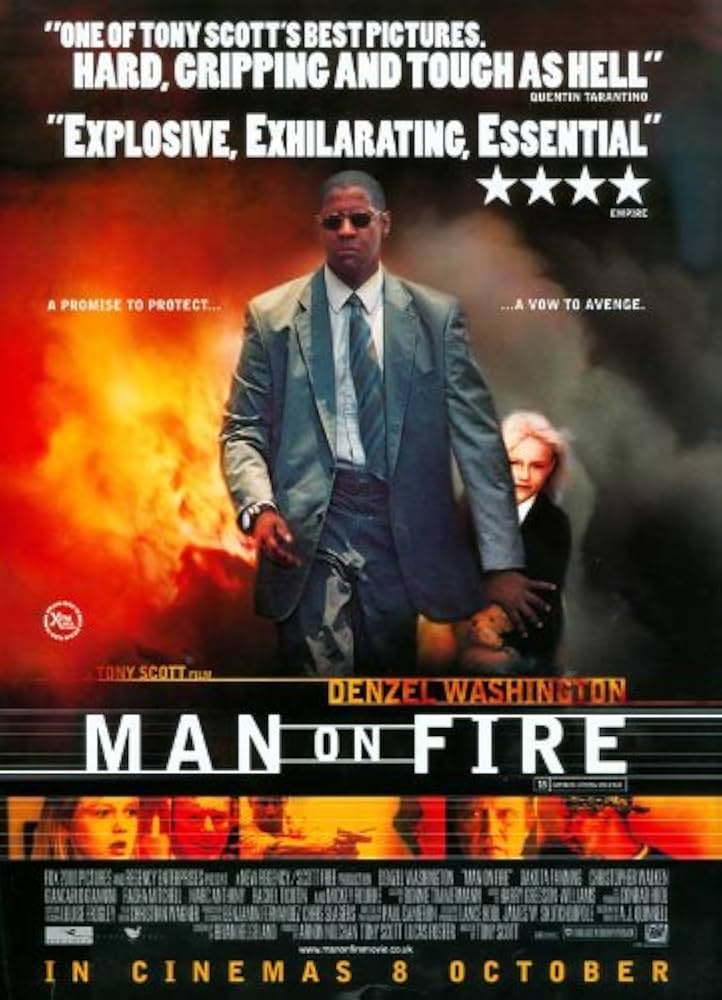
Man On Fire (2004)

Hard-drinking, burnt-out ex-CIA operative John Creasy has given up on life until he's hired as a bodyguard to protect 9-year-old Pita Ramos. Bit by bit, Creasy begins to reclaim some of his soul, but when Pita is kidnapped, Creasy's fiery rage is finally released and he will stop at nothing to save her as he sets out on a dangerous, revenge-fueled rescue mission.
Sabotage his work, his fire will be released.
Elderly Man: In the church, they say to forgive.
Creasy: Forgiveness is between them and God. It's my job to arrange the meeting.
Ciudad Ju?rez, Chihuahua, Mexico
Naples, Campania, Italy
El Paso, Texas, USA
Mexico City, Distrito Federal, Mexico
Puebla, Mexico
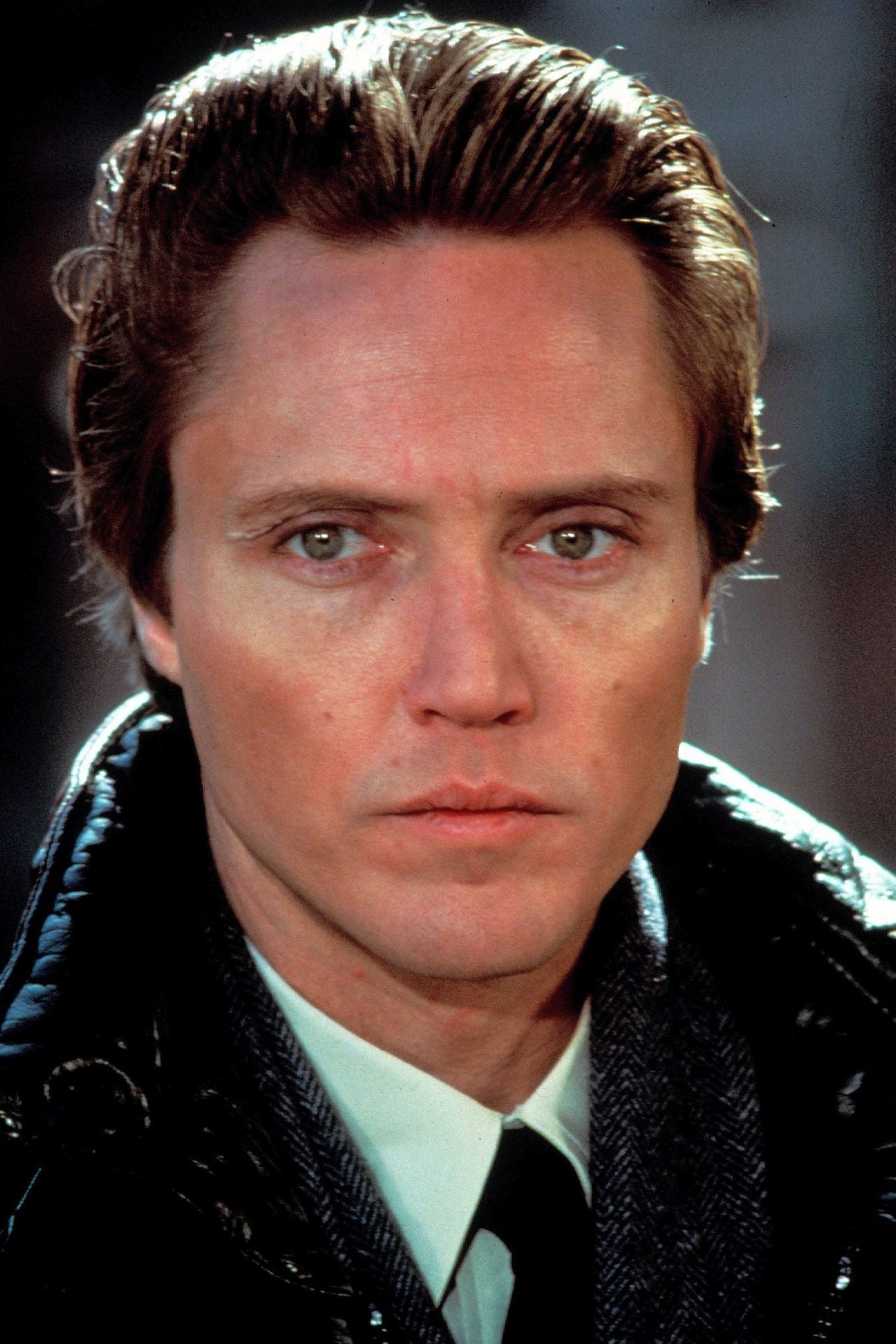

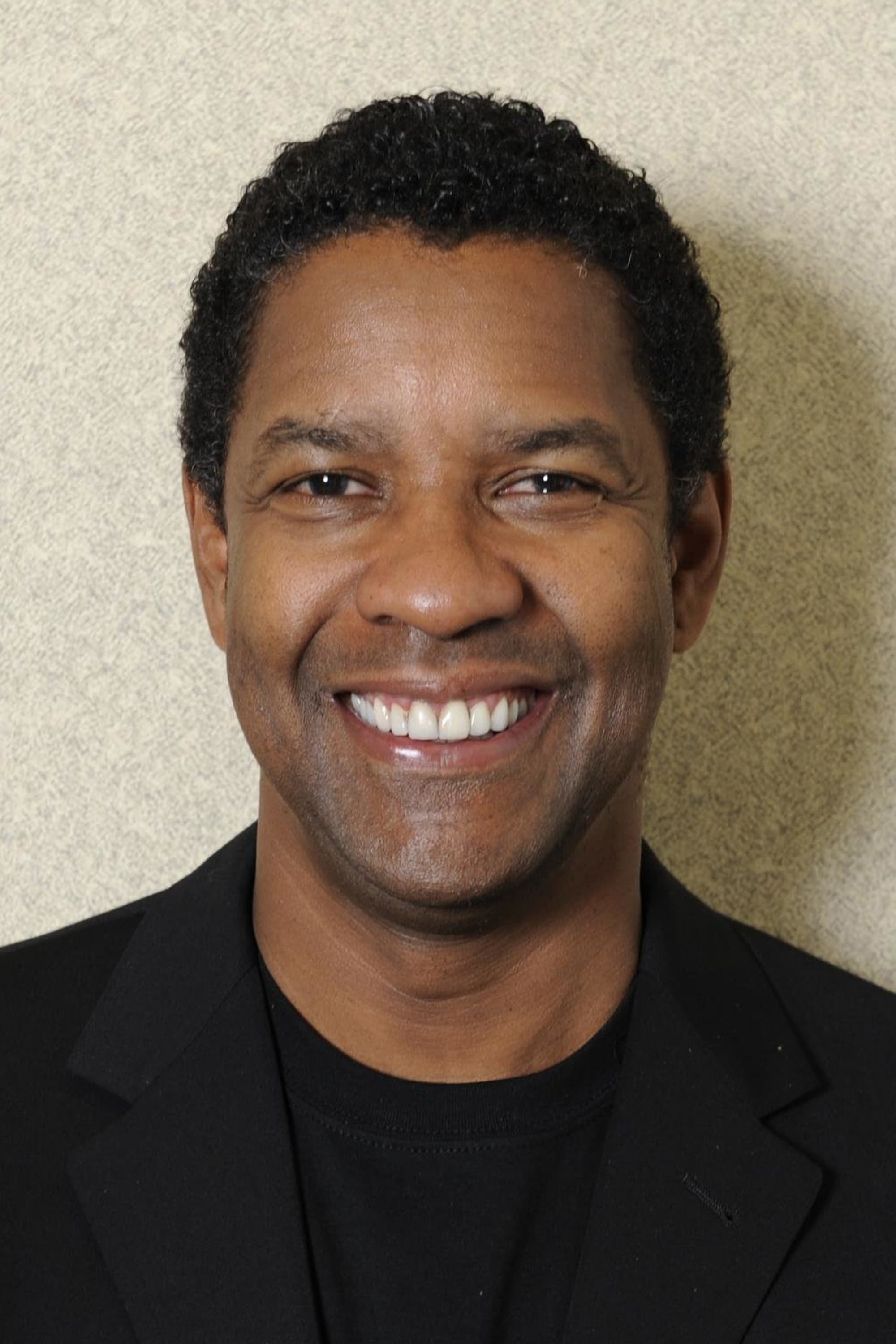
Most of the scenes between Denzel Washington and Christopher Walken were completely improvised.
Writer Brian Helgeland first saw the original Man on Fire (1987) when he was renting videos in the late '80s. He walked in to the video store where Quentin Tarantino was working and asked what was good. Tarantino recommended "Man on Fire".
Denzel Washington was so impressed with Dakota Fanning's acting that he'd watch her and forget he was in the scene.
The kitchen scene between Creasy and Pita, where she asked him about concubines, was mostly ad-libbed. It started when they "accused" each other of smiling.
Denzel Washington was cast because of a trip to a doctor. He ran into director Tony Scott in the waiting room of a medical office and the two started chatting. Scott had not seen Washington in person since they worked together on Crimson Tide (1995). Scott happened to see Dakota Fanning in I Am Sam (2001) the night before and seeing him made Scott think of using them together.
Continuity
When Creasy is talking to "The Voice" on the roof, the cellphone changes between three different Motorola phones.
In the kidnapping scene the driver of the kidnapper's car reverses into the taxi at relatively high speed, which would have caused easily visible damage. When the kidnapper picks up Pita and the car is driving away the back end is clearly visible and is 100% intact.
When Creasy is standing on the bridge before taking his final walk, there is a shot which shows his St. Jude medallion hanging visibly outside his shirt, but after a cut-away, he is next shown pulling the medallion out.
When Creasy is under the bridge with Fuentes, he takes the latex glove off of his left hand. He then walks around the car and takes the left glove off again.
When Creasy and Rayburn are driving in Rayburn's truck, Creasy hands Rayburn a list of the weapons he wants. The page is torn from Pita's diary, which Creasy has not yet collected.
Factual errors
Captioning mistranslation. Fuentes tells Samuel that he has been authorized to participate "ex officio", and the caption translates this as "unofficially". However, "ex officio" means "by virtue of the office", in this case Fuentes' position in the Anti-Kidnapping Division.
Despite being a relatively common trope in movies, an experienced soldier would never fire an RPG indoors. The back blast would likely kill everyone inside the confined space of that living room, where hot gasses would be deflected by the walls and ceiling. At the very least, the ancient couple, the birds and Denzel's character himself would have been severely injured.
The Kidnappers instruct Ramos to wait for a call in a public payphone in Avenida Reforma. Mexico City "Ladatel" card payphones can't receive calls. And, more specifically, the phone shown in the movie where the instructions are supposedly posted is the regular kind, which can't receive calls.
After Samuel Ramos shot himself with Creasy's bullet; the gun can be seen on the floor with the slide locked in the open position. That would only happen if an empty magazine was inserted into the gun, but Creasy had removed the magazine beforehand and Samuel loaded the bullet manually into the chamber. After firing the single bullet, the slide would close forward again.
The misfired bullet Creasy carries around with him shows a circular dimple in the primer. This bullet would not have come from his Glock since this pistol leaves an oval shaped indentation.
Incorrectly regarded as goofs
Mariana tells Creasy that Fuentes is more heavily guarded than the president and travels by motorcade. It would stand to reason that, since he has money and influence, the car he travels in would be armored and with bullet resistant glass. Creasy doesn't shoot through the car at any time. It clearly shows bullets hitting the windshield, but not entering the vehicle. If they had, both occupants would have been killed. Creasy knows this and then tosses a f Pyro-grenade under the vehicle. This causes the driver to exit the car, and only then does Creasy shoot him.
After Creasy frees the young Mexican girl and walks out onto the dance floor shooting, the crowd doesn't panic, or begin any other rational action - they just keep dancing and working their way toward the door. And once they're outside they continue dancing (at a safe distance) outside the dance hall until and even after the dance hall explodes. No one is in fear; they just keep dancing and cheering. It IS a rave party in Mexico, after all - intoxication, the mental confusion induced from the music and lights, and the close relations with guns in that society, would not create a state of alertness or danger. No one (visibly) died, either - the patrons were corralled outside _before_ the explosions, so there was no sense of danger, and no emotional distress.
Revealing mistakes
When Pita is writing down the license plate of a car following them, she states that she got all the numbers except for the last digit. Later, when Creasy browses through Pita's diary however, she has noted the complete number (C5T-K89), but the last digit had been erased afterwards.
When Creasy holds his Glock pistol to Gonzales' head and tells him to drive, the pistol's trigger is in the rearward position, meaning the firing mechanism is not cocked, and there is no round in the chamber. Chambering a round in a Glock pistol cocks the firing mechanism, which puts the trigger in the forward position. It can be assumed that a former special operator and assassin like Creasy would ensure his pistol is loaded and has a round in the chamber before using it.
When Creasy shoot's the kidnappers' car's driver-side window, a plastic shield can be seen in the window frame, protecting the actors from the breaking window glass.
Lisa Ramos is played by Australian actress Radha Mitchell. Lisa is supposed to be American but in many scenes her accent obviously slips back towards Australian, especially when she is yelling.
After Creasy has fired the RPG into the Jeep in the motorcade and then first starts to drive off with Fuentes, the back-up lights of Fuentes's car are on, and then a moment later they are off once the car is out of the fire (this is probably because the car was filmed driving backwards into the fire, and then the film was run backwards to create the stunt).
Miscellaneous
In the end credits where the various regional authorities are thanked, they list the Government of the State of Chihuahua twice (Gobierno del Estado de Chihuahua), first at the top of the list of Chihuahua acknowledgments, and again at the bottom.
Crew or equipment visible
When Creasy and Rayburn are leaving by car the dog hospital you can see the far end of the dolly tracks at the end of the shot. The cameraman notices it and tilts the camera up a bit.
When Creasy opens the door and enters Aurelio Sanchez's house, you can see in the window on the door the reflection of someone (possibly the director) wearing a red baseball cap.
In the scene where Creasy is cutting off the man's finger in the car, if you look closely in the background you can see a crew member steps into the shot.
When Creasy is cutting off the fingers of Jorge Gonzales, in a supposed secluded area, a man's arm can be seen in the window behind Creasy.
At around 49 min mark, when Creasy is sitting on a bench playing with the dog, the flower placed in his buttonhole can clearly be seen 'attached' to his shirt in place using a cellophane tape.
Errors in geography
At the middle of the movie, the camera takes an aerial shot of an orange building, with the captions telling you is the Mexican Police Headquarters. In reality, that building is a major hospital on the Interlomas zone.
Plot holes
The kidnapper's nephew gets killed... and they still don't know who the kidnapper is? Plus the kidnapper is very cautious about his identity yet he openly discloses that it is his nephew that got killed.
Boom mic visible
Towards the end of Pita's second swim race, a boom microphone is visible in the top left of the shot, just prior to her finishing and running up to Creasy.
Character error
After Pita is kidnapped, the police chief gives her full name as "Pita Martin Ramos". Not only is the child's real first name "Lupita," but according to Mexican name customs, the father's surname should go first, making it "Lupita Ramos Martin".
At around ten minutes, when the husband (Marc Antony) is pre-interviewing Creasy (Denzel Washington) in the car, the audience is presented with a resume shot containing an excerpt of Creasy's extensive credentials. In the resume his name is printed as "Mr. Rosche", but his character's name is John Creasy.