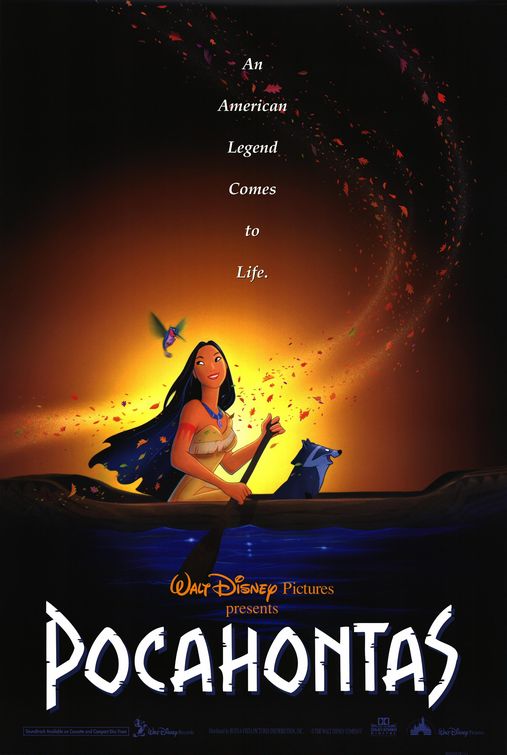
Disney's Pocahontas (1995)

History gets the Disney kiddie treatment and a politically correct interpretation in the studio's 33rd feature-length animated movie, the first to be based on actual events and people. Pocahontas (Irene Bedard) is the daughter of Algonquin chief Powhatan (Russell Means), who promises her in marriage to Kocoum, a brave whom she doesn't love. Pocahontas would rather be paddling in her canoe or wandering in the forest, communing with nature and her animal pals, Meeko, a raccoon, and the hummingbird Flit. When European settlers arrive, she becomes enamored of handsome John Smith (Mel Gibson). Their attraction is encouraged by Grandmother Willow (Linda Hunt), a talking tree. The situation between their peoples is tense, however, as the settlers, led by Governor Ratcliffe (David Ogden Stiers) desperately want the gold that they're sure the natives are concealing. When a dutiful sentry, Thomas (Christian Bale) follows Smith into the woods on one of his secret meetings with Pocahontas, a tragic mistake leads both groups to the brink of war. Only the love of Pocahontas and Smith can prevent bloodshed. Pocahontas (1995) was awarded two Oscars, for Best Original Musical or Comedy Score and Best Original Song for "Colors of the Wind."
An American legend comes to life
Powhatan: My daughter speaks with the wisdom beyond her years. We've all come here with anger in our hearts, but she comes with courage and understanding. From this day forward, if there is to be more killing, it will not start with me.
Walt Disney Studios, Burbank, California, USA
A song titled "If I Never Knew You" was cut after children in test audiences found it boring. At the time, it was almost fully animated, with the exception of color. For the film's 10th anniversary DVD release, the animation was completed and the song inserted back into the film, as well as a short reprise in the final scene.
Actress Irene Bedard, who provided the voice of Pocahontas, was also the physical model for the animated character.
When ABC aired Pocahontas (1995) in 1997, they showed the cut music scene for "If I Never Knew You", sung by Mel Gibson and Judy Kuhn. The animation was just the black-and-white pencil sketches (no color).
The Europeans using matchlock muskets was a nice touch. This is exactly what mariners would be using at the time, as the wheellock was too delicate and expensive and the snaphaunce (forerunner of the flintlock) was still too new and unreliable for general use (especially at sea).
This is the only Disney animated movie inspired by fact.
The Disney executives had all the secondary animal characters, such as Meeko and Flit, lose all their dialog in order to make the film a bit more serious.
Animators working on the film regarded "Pocahontas" as being one of the hardest films ever produced by the studio. The complex color schemes, angular shapes and facial expressions meant that the film was in production for 5 years. The hard work paid off, however. Pocahontas herself is now frequently cited as being one of the most beautifully and realistically animated characters in the Disney canon, her fluid movements mainly being attributed to rotoscoping.
The film's premiere was a huge event in Central Park. With over 100,000 people attending, it holds the record for the largest movie premiere.
In their quest for authenticity, the Disney studios hired mostly Native American actors to do the voices. They also employed Native American consultants and had a session with a real shaman. Despite these efforts, prominent Native American activists issued an open letter condemning the film for its historical inaccuracies and stereotyping of the Indian people.
The first film to feature Mel Gibson singing.
"Pocahontas" was put into production at the same time as The Lion King (1994). Much of the animating talent at the studio opted to work on "Pocahontas" as they saw it as more of a prestige production than the latter film.
The animation style is of a more flat and geometric appearance, first employed by the studio back in 1959 on Sleeping Beauty (1959) and in 1961 on One Hundred and One Dalmatians (1961). It would be a style that was re-used on Hercules (1997) (1997) and, to a lesser extent, on Mulan (1998) (1998).
"Colors of the Wind" was the first song written for the production and helped define the tone and direction of the film.
John Pomeroy was the supervising animator for John Smith and watched a number of 'Erroll Flynn (I)' movies to get the movements of the character down pat. Once the look of Smith was finalized, 14 other animators were drafted in to make him come to life.
At the time, Disney cartoons traditionally featured a show-stopping musical number. Previous examples would include the "Kiss the Girl" segment from The Little Mermaid (1989) (1989), "Be Our Guest" from Beauty and the Beast (1991) (1991) and "Friend Like Me" from Aladdin (1992) (1992). This proved to be problematic however with "Pocahontas" as the story didn't really lend itself to such an ornate production number. Stephen Schwartz and Alan Menken penned several songs, of which the leading contender was a song called "In the Middle of the River", but it was eventually dropped when it was decided that the song simply didn't fit within the dramatic context of the story.
John Candy had provided a large amount of voice work into a character named "Redfeather", a turkey, and Pocahontas's sidekick. However after Candy's death in 1994, the concept was scrapped.
The world premiere was staged at Central Park, NYC, on June 10, 1995. 70mm prints were projected on three enormous screens, and the sound was offset by twelve frames to accommodate the vast seating area.
Originally the animal characters had dialogue, just like in previous Disney features. This was dropped when the filmmakers pushed for a more realistic treatment of the story. One character, a turkey named Redfeather, was dropped entirely.
Many at Disney had high hopes for the movie upon initial release. Then studio head Jeffrey Katzenberg regarded it as a more prestigious project than The Lion King (1994), and even believed that it had a chance of earning an Academy Award nomination for "Best Picture", following in the steps of Beauty and the Beast (1991). However, the movie was less successful commercially than was hoped. Because the film dealt with more adult themes and tones, it did not appeal to younger children as much as earlier Disney hits had.
In the very first draft of the script the character of "Grandmother Willow" was written as a male character who was the spirit of the river, the character was named "Old Man River". The song "Just Around the Riverbend" was written for this character to be sung. Gregory Peck was offered the role and as much as it pained him to do it, turned down the role because he felt the title character needed a motherly figure to turn to for advice. Soon the filmmakers agreed with him and the character was changed.
Howard Ashman was going to write lyrics for the songs of this film as soon as he finished writing lyrics for the songs in 'Aladdin (1992)', he died before he could finish the lyrics for the songs in Aladdin, so there for did not write any lyrics for any of the songs in this film.
Continuity
At the beginning of the storm the Union Flag is torn by the storm. Later in the scene, the flag is restored
John Smith's helmet disappears and reappears throughout the movie.
Incorrectly regarded as goofs
There are many historical inaccuracies in this story of Pocahontas, however this is (obviously) a highly fictionalized account of her life.
Factual errors
Indians didn't plant corn in rows. .
Factual errors
Pocahontas follows a compass to the north, while the sun is rising. Her shadow is to her right, when it should be to her left.
Anachronisms
In some scenes the Union Flag of Great Britain and Ireland is displayed, although this flag was not created until 1801 (nearly 200 years after the movie is set). In other scenes, the St Patrick's cross is omitted.
Errors in geography
Meeko the raccoon hides atop a moose. There are no moose in Virginia, or anywhere in the warm areas of North America.
There are many cliffs visible near Jamestown. The land in Virginia near Jamestown is flat.
Ratcliffe's maps show the island of Hispaniola (today divided between Haiti and the Dominican Republic) underneath Florida, where Cuba should be. Although 17th Century maps are known to be inaccurate, a mistake this obvious is unlikely given that the Caribbean area was well charted by then.
When the Native Americans are preparing for the battle, they are surrounding a big "fire". Before they move to start the battle they are all walking towards the center of the circle. As they do this everyone's shadow is right in front of them; as if the sun was behind all of them. This isn't possible since at least half of their shadows would be behind them and not in front of them.