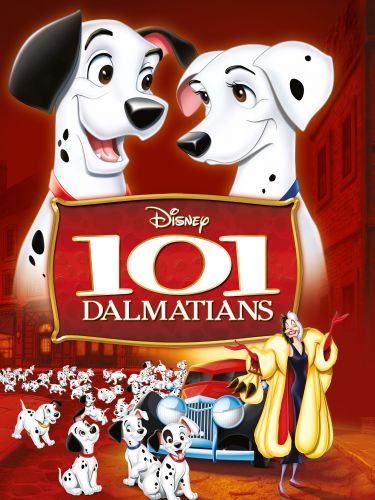
Disney's One Hundred and One Dalmatians (1961)

Pongo is a male Dalmatian living in London with his master, Roger, a bachelor songwriter who has yet to sell his first tune. Bored with their single existence, Pongo arranges for Roger to meet Anita, a pretty young woman who just happens to have a female Dalmatian named Perdita. It is not long before love blossoms all around and a double wedding takes place. A few months later, Perdita gives birth to 15 puppies, much to the delight of Cruella De Vil, a wealthy, wicked former schoolmate of Anita's whose burning passion is to own a coat made of Dalmatian pelts. When she is unable to purchase the puppies, she has them "dognapped" and brought to her crumbling estate in the country, where 84 other Dalmatians are also being held captive. All attempts by the police to find the missing pups fail, and the desperate Pongo and Perdita appeal to the dogs of London, via the "twilight bark." Led by The Colonel, an indomitable shaggy dog and a cat named Sergeant Tibbs, all dogdom comes to the rescue and, aided by geese, cows, and horses, tracks down the missing puppies.
It's A Comedy - It's A Mystery - It's A Thriller - It's New - It's Different - It's Delightful - It's FUN !
Roger: Look, Anita! Puppies everywhere!
Anita: There must be a hundred of them!
Walt Disney Studios, 500 South Buena Vista Street, Burbank, California, USA
Disney was in debt following the flop of Sleeping Beauty (1959) and desperately needed a hit. There was even talk of closing down the animation division as the company was refocusing on live action films, television and theme parks.
Clarence Nash (best known as the voice of Donald Duck) did the dog barks for this film.
The birth of the puppies actually happened to the author Dodie Smith. Her dalmatians had 15 puppies, one was born lifeless and her husband revived it. However, they sold most of them, and kept only a small number.
Xerox was a crucial help in the animation of hundreds of spotted dogs. Disney was able to bring the movie in for about half the cost thanks to this process.
Due to the commercial failure of Sleeping Beauty (1959), production costs needed to be cut. As a result, this was the first Disney feature film to use photocopying technology (Xerography), which made an animated film with this much visual complexity possible. It also set the visual style of Disney animation (a scratchy, hard outline look) for years until the technology advanced enough (with the production of The Rescuers (1977)) to allow a softer look.
The filmmakers deliberately cast dogs with deeper voices than their human owners so they had more power.
When Walt Disney read Dodie Smith's story in 1956, he immediately snapped up the film rights. Smith had always secretly hoped that Disney would do just that.
(at around 35 mins) Characters from Lady and the Tramp (1955) are shown in brief cameos during the Twilight Bark scene: Jock is first shown coming out of a doghouse and then barking into the drainpipe to a dog in an upper apartment. The strays Peg and her friend the bulldog are seen in a pet shop with various puppies, and both Lady and Tramp are shown very briefly with several dogs at the end of the scene when the barking reaches across the entire city.
The author of the book on which the film is based, Dodie Smith, was a successful playwright and novelist who had nine Dalmatians of her own, including one named Pongo. She got the idea for the book when a friend who was at her house saw all the dogs together and remarked, "Those dogs would make a lovely fur coat."
(at around 1h 5 mins) The scene where the puppies suckle from some friendly cows attracted a lot of criticism at the time of release as it was deemed to be inappropriate for a children's film.
Note that the male puppies wear red collars and the females wear blue ones, as always seen with Pongo and Perdita.
In the book, Roger is not a struggling composer but a financial wizard who helped wipe out Britain's national debt.
The dogs aren't actually white-they're very light grey. White would have been too bright on screen, and wouldn't have worked well in the snowy scenes.
(at around 23 mins) When the puppies are watching TV, you can see that the spots on Lucky's back form a horseshoe - a symbol of good luck.
Cruella De Vil was designed as a manic take-off on the flamboyant actress Tallulah Bankhead, as well as some of her personality quirks.
Barbara Luddy (the voice of Lady in Lady and the Tramp (1955) and Merryweather in Sleeping Beauty (1959)) provided the live referencing for Nanny.
Disney Feature Animation later adopted "The Twilight Bark" as the name of their internal newsletter.
Out of the 15 puppies Perdita gives birth to, only 6 are named in this film (Lucky, Rolly, Patch, Penny, Pepper, and Freckles). Other incarnations like the live action film and the TV series revealed 6 other names (Wizzer, Dipstick, Two-Tone, Cadpig, Fidget and Jewel), which combined still leaves 3 puppies unnamed.
In the early 1990s merchandise tied-in with the video's release was quickly pulled from shelves because the word Dalmatian had been spelled incorrectly as "Dalmation" on some of the product packaging. The merchandise was only available at Disneyland or the Disney Stores.
Contrary to popular belief, the cartoon that the puppies watch on the TV in Hell Hall is not Flowers and Trees (1932). It is actually Springtime (1929).
The 1991 re-release was the 20th-highest-grossing film of the year.
Walt Disney disliked the rough drawing style brought about by the Xerography process.
At the time of its release in January 1961, this was the biggest grossing animated film of all time. However, it was overshadowed by Guns of Navarone, another British film made by Columbia Pictures four months later, to become the highest grossing film of 1961 at over $28 million.
Lucille Bliss, the voice of Anastasia in Cinderella (1950), sings the Kanine Krunchies theme song.
Bill Peet kept in close consultation with Dodie Smith whilst preparing the story, including sending her some sketches of the characters. Smith felt that the Disney studios were improving on her story.
Quite a few liberties were taken in bringing the book to the screen. In the original story, the two Dalmatians who ran across England to rescue their pups were named Pongo and Missis Pongo, or just plain Missis; Perdita was a stray whose own puppies had been sold, and who was taken into the household to help wet nurse Missis' fifteen puppies. In the film, their owners are named Roger and Anita Radcliffe; in the book, they're Mr. and Mrs. Dearly, no first names given. The book also features two Nannies (Nanny Cook and Nanny Butler) to the film's one; Jasper appears under the same name in both versions, but Saul is changed to Horace for the film; and Tib, the book's heroic gray tabby female, is transformed into an orange-colored tom. However, the film was not the first time the story had undergone changes; "The Hundred and One Dalmatians" first appeared as a serial in Ladies' Home Journal, under the title "The Great Dog Robbery".
HIDDEN MICKEY: In the opening credits and also on almost all the Dalmatians.
Someone counted all black spots in the movie, frame-by-frame, and reached the total of 6,469,952. This breaks down to 72 spots on Pongo, 68 on Perdita and 32 on each pup.
To cut costs, the studio was forced to reduce its staff of inkers from 500 to less than 100.
Lisa Daniels only provided about a third of Perdita's voicework in the film. Halfway through the movie's lengthy production, she got married and moved to New York City so Cate Bauer completed the vocal performance.
Cruella's telephone reflects her mood! Watch the face on it closely each time Cruella's mood changes.
Bill Lee is Roger's singing voice. Four years later, he would go on to provide the singing voice for Captain von Trapp in The Sound of Music (1965). Ben Wright who provides Roger's speaking voice also appears in The Sound of Music as Nazi Gauleiter, Herr Zeller.
Art director Ken Anderson came up with the idea of overlaying cels of line drawings over the painted backgrounds to match the Xeroxed cels of the characters. For the next twenty years, all Disney features - with the exception of The Jungle Book (1967) and the animated segments in Mary Poppins (1964) and Bedknobs and Broomsticks (1971) - would use this technique for their backgrounds. With The Fox and the Hound (1981), Disney returned to fully painted backgrounds, with a brief reprise of the cel overlay for Oliver & Company (1988).
Premiered at the famed Radio City Music Hall in New York City.
On previous Disney animated features, the top animators were assigned a character and drew the bulk (if not all) of that particular character's scenes individually. Animation on this film was far more of a "team effort" - for example, seven of the famed "Nine Old Men" worked on Perdita. There was one notable exception: Marc Davis drew Cruella De Vil entirely on his own.
(at around 3 mins) The author, Dodie Smith, noted that her favorite cel in the movie was the one where Pongo stretches while lying on a window sill near the beginning.
Helene Stanley acted as the live-action reference model for Anita, as she had done for the title character of Cinderella (1950) and Princess Aurora in Sleeping Beauty (1959).
When Bill Peet sent Dodie Smith some drawings of the characters, she wrote back saying that he had actually improved her story and that the designs looked better than the illustrations in the book.
800 gallons of special paint weighing nearly 5 tons were used in producing the animation cells and backgrounds - that's enough to cover 15 football fields or the outsides of 135 average homes. Nearly 1,000 different shades of colour were created.
Chuck Jones once commented that only Walt Disney would make an animated film about one hundred and one dalmatians: "if I had tried to make One Dog Named Spot for Leon Schlesinger, he would not let me do it. Spots cost money."
There is a scene where The Colonel and Jasper come face to face. They are both voiced by the same actor, being J. Pat O'Malley.
Mary Wickes, who did live reference for Cruella De Vil, would later go onto voice Lavern the Gargoyle 35 years later in The Hunchback of Notre Dame (1996).
The various vehicles in the movie are live-action models painted white with black lines. Each frame of the live-action footage was Xeroxed onto cels and painted the same as the hand-drawn characters. This would become standard procedure at Disney and other studios until the mid-1980s, when computer animated models first came into use.
The final film for animator Marc Davis. After animating Cruella De Vil in this film, Davis went to work for WED Enterprises, designing for such Disneyland rides as the Haunted Mansion and Pirates of the Caribbean.
Bill Peet was assigned the task of writing the story, making him the first man at the Disney studios to single-handedly create the story for one of the animated features.
Walt Disney was said to have been so disappointed in the layout work done by Ken Anderson on the film that he did not forgive him until the end of his life.
The production of the film signalled a change in the graphic style of Disney's animation. Sleeping Beauty (1959) had a more graphic, angular style than previous Disney films, and Dalmatians had an even more stylized look, inspired by British cartoonist Ronald Searle, which would become the norm for Disney animation for years to come.
According to Lisa Davis, Walt Disney took Cruella's look from Zsa Zsa Gabor, who was known for wearing fur coats. Though Davis made use of her exceptional Zsa Zsa impression to read for Cruella, she felt that she was better suited to the role of Anita. Walt listened to her read some of Anita's lines and ultimately agreed that it was a perfect fit.
(at around 31 mins) When the Baduns are talking on the phone to Cruella, they are holding a newspaper. The only headline on the front page (apart from the dognapping) is CARLSEN SPEAKS, and a picture of a capsized ship. This helps us to date the story, since the Carlsen in question is Henrik Kurt Carlsen, captain of the freighter Flying Enterprise, which sank after a prolonged struggle in the Atlantic. This was the media event of the year in 1952. However, at the very beginning of this scene, on the front pages of the newspapers that Cruella is reading, just right under the masthead, you can clearly read the date, which is November 2 (Sunday), 1958.
This is one of two films in the Disney animated canon to feature cigarette smoking, cigar smoking, and pipe smoking, the other one being The Great Mouse Detective (1986).
The final Disney animated feature film that Les Clark worked on before his retirement.
2 of the Voice Actors in this film had previously been the Narrators in 2 Previous Disney Animated Movies prior. Betty Lou Gerson who did the voice of Cruella De Vil and Miss Birdwell previously did the Opening Narration in Cinderella (1950), whilst Tom Conway who did the voice of The Quizmaster and The Collie previously did the Opening Narration in Peter Pan (1953).
Songwriter Mel Leven wrote several additional songs for it including "Don't Buy a Parrot from a Sailor", a cockney chant, meant to be sung by Jasper and Horace at the De Vil Mansion, and "March of the One Hundred and One", which the dogs were meant to sing after escaping Cruella by truck.
Although Walt Disney had not been as involved in the production of the animated films as frequently as in previous years, nevertheless he was always present at story meetings. However, he felt that Bill Peet's original draft was so perfect that he had little involvement in the making of it altogether.
In the scene when Horace and Jasper are watching television, the TV show they're watching "What's My Crime" is loosely based off of a current TV show called What's My Line? (1950). What's My Crime consists of a panel asking several questions to guess what crime the guest has committed, while in What's My Line? (1950) is the same but the panel tries to guess who the mystery guest is while blindfolded.
Originally, Bill Peet planned to have the puppies cheering more during the television scene. At a story meeting Walt Disney commented that most children didn't show any reaction when watching television and related that his own grandson recently didn't look away from the television when he had come to visit. Peet, who was not on the friendliest terms with Disney at that point, remarked 'Maybe he didn't know who you were.' Peet later commented that the other artists all had to stifle their laughter, but that Disney 'didn't like that one damned bit.'
In the book, Roger and Anita's last name was Dearly instead of Radcliffe. Presumably, Walt Disney changed it since they already had two similarly named couples: Jim Dear and Darling from Lady and the Tramp (1955), and George and Mary Darling from Peter Pan (1953). However, Dearly would later be used as their surnames in 101 Dalmatians (1996) and 101 Dalmatians: The Series (1997).
Walt Disney originally had Lisa Davis read the role of Cruella De Vil, but she did not think that she was right for the part and wanted to try reading the role of Anita. Disney agreed with her after the two of them read the script for a second time.
CASTLE THUNDER: Various versions are used during the storm while the puppies are born. The version used on Bambi (1942) is heard when Cruella enters, and again when she leaves and Pongo barks at her.
This was the first time that the story for a Disney film was created by a single person (Bill Peet).
It took nearly all of Disney's Nine Old Men to work on animating Perdita. While Ollie Johnston was her primary animator, Frank Thomas, John Lounsbery, Les Clark, Milt Kahl, Eric Larson and (though uncredited) Ward Kimball did the animation for the character as well. Marc Davis was working as the sole animator for Cruella De Vil, and Wolfgang Reitherman was directing the film.
The Sherman Brothers had written a song for the film that was intended to be the film's opening theme. The song never made the final film for reasons unknown.
Included among the American Film Institute's 1998 list of the 400 movies nominated for the Top 100 Greatest American Movies.
Cruella De Vil ranked as #39 on the American Film Institute's 2003 list of Top 50 Greatest Movie Villains.
The new Xerox process had been initially tried out on the animated short Goliath II (1960).
Pongo ranked as #24 on Ultimate Disney's Top 25 Disney Heroes.
Wolfgang Reitherman's feature film debut as a director.
It is the second Disney animated film to be set in a present day. The first one was Dumbo (1941). Some may point Lady and the Tramp (1955) as the second Disney film in a present day, but it leans more to the turn of the century in the late 1900's to early 1910's, thus making 101 Dalmatians the second Disney film set in a present day.
Rod Taylor was one of the first voices cast.
In 2008, the American Film Institute put together a list of the Top 10 Animated Films. While this movie didn't make the Top 10, it was one of the 50 films nominated for the list.
In February 2015, 101 Dalmatians was released on Blu-Ray for the first time.
There are 10 music cues in the opening sequence.
101 Dalmatians is 1 hour and 19 minutes long, and it has 113,760 frames. Disney's The Sword in the Stone (1963) is also 1 hour and 19 minutes long, and it also has 113,760 frames.
This film was shot in Standard Academy (1.33:1), although it was designed to be matted to a ratio of 1.75 for widescreen-equipped theaters. When re-released in the mid-1990s, the entire 1.33 frame was matted within a 1.85 (flat) viewing area, so that the entire animated frame could be seen, since most modern theaters no longer have the equipment to run films in Academy ratio.
On February 11, 2015, a special screening of the movie was shown at Disneyland to promote the release of the Diamond Edition Blu Ray. It was held in the Fantasyland Theater and was hosted by Disney Historian, Tim O'Day, and Disney animator, Andreas Deja.
Walt Disney Animation Studios' first film since Bambi (1942) (which only had songs sung in the background) to not be a musical of characters breaking into songs 3 or more times at random moments.
Perdita ranked as #22 on Ultimate Disney's Top 25 Disney Heroines.
Cruella De Vil was ranked #6 on Ultimate Disney's Top 30 Disney Villains.
The character Cruella De Ville is pictured on one of ten USA nondenominated commemorative postage stamps celebrating "Disney Villains", issued as a pane of 20 stamps on 15 July 2017. The set was issued in a single sheet of 20 stamps. The price of each stamp on day of issue was 49?. The other villains depicted in this issue are: The Evil Queen from Snow White and the Seven Dwarfs (1937), Honest John (Pinocchio (1940)), Lady Tremaine (Cinderella (1950)), The Queen of Hearts (Alice in Wonderland (1951)), Captain Hook (Peter Pan (1953)), Maleficient (Sleeping Beauty (1959)), Ursula (The Little Mermaid (1989)), Gaston (Beauty and the Beast (1991)), and Scar (The Lion King (1994)), she is also the only of the ten to appear in a non-musical feature.
Before the release of the 2015 Diamond Edition Blu-Ray, the Platinum Edition was reissued in the U.K. as a Blu-Ray in 2012.
As of 2009, this movie was ranked as #14 on Ultimate Disney's Top 20 Disney Animated Features.
The Platinum Edition DVD of this movie was one of the biggest-selling DVD's of 2008.
One of only two Disney animated non-musical feature films to have 3 songs, the other being The Great Mouse Detective (1986).
This is Hamilton Luske's last Disney film he directed.
The emblem depicted on the hubcaps of Cruella's car toward the end of the movie is made up of her initials: C.D.
Walt Disney Animation Studios' seventeenth feature film and first one of the 1960s.
Martha Wentworth (Nanny, Lucy the Goose, and Queenie the Cow), Tudor Owen (Towser), Thurl Ravenscroft (Captain), Rickie Sorensen (Spotty), and Junius Matthews (Scottie) were later reunited in The Sword on the Stone, two years later.
Betty Lou Gerson, who had previously provided her voice as the narrator of the opening scenes of Cinderella, was inspired by Tallulah Bankhead when voicing Cruella De Vil. This is interesting as it is said that Dodie Smith originally conceived the character as an evil parody of Bankhead. When performing, Gerson was intimidating even to the other actresses working with her. She was the primary inspiration for Marc Davis when animating Cruella. Davis commented that the vocal performance suggested that "this character was bigger than life, high in energy, and, like a shark, always moving".
Walt Disney Animation Studios' first film since Peter Pan (1953) to be shown in the 1.85:1 aspect ratio.
When Sargent Tibbs goes into the De Vil mansion (around 43 minutes in) the show that the puppies are watching is actually a black and white version of one of Disney's Silly Symphonies.
For a long time, it is unknown who voiced Scottie during the twilight bark scene, due to him being uncredited.
The third Disney full length animated film set in the U.K. The first two were Alice in Wonderland (1951) and Peter Pan (1953).
In the Italian version, Cruella De Vil is renamed Crudelia De Mon, being the name Crudelia derived from the Italian word for "cruel".
The third Disney animated feature film to release in January after Pinocchio (1940) and Sleeping Beauty (1959).
One of the lines in the Cruella de Vil song -- which is cut from the actual movie, but does appear in music video versions of the song -- is "all innocent children had better beware". Roger had no idea how accurate that statement later turned out to be (well, if you're a dalmatian child, anyhow).
Rod Taylor's background in radio was instrumental in helping him land the voice role of Pongo.
Dodie Smith was delighted with the finished result.
Cruella de Ville's movements and style were inspired by Bette Davis, Rosalind Russell and Tallulah Bankhead.
Bill Peet was assigned to write the screenplay. As he never learned to type, Peet's first draft was written longhand.
According to Disney there were 6,469,952 spots painted on the dogs.
In The Chef Pee Pee Goes To Hollywood, He Mentions That He Is The Copy Of 101 Dalmatians, But Later Logan Make An Idea Of It
Anachronisms
Kanine Krunchies sponsors the Thunderbolt show but in the 1960s, advertisers could not directly sponsor programs in the UK.
Audio/visual unsynchronised
(at around 12 mins) After Perdita goes into hiding when Cruella first arrives, the camera cuts to Roger while he's saying "Cruella De Vil", but while he's saying it, his mouth doesn't move.
In the beginning before the title appears, you see Pongo barking with a hat in his mouth. There is no way he could have done this without the hat falling out.
Continuity
(at around 9 mins) When Anita is pulled from the pond, the book she was carrying has become a handbag.
(at around 9 mins) In the park, Roger is dragged away from the park bench where his hat is sitting, but is shown wearing it seconds later.
When the dogs are moving up the frozen creek, Lucky's ears change from white to black.
(at around 26 mins) After watching TV, when the puppies are going off to bed, when Pongo counts puppies 8 through 14 (seven puppies), there are only five puppies, including Rolly, who actually go through the door.
(at around 15 mins) After Cruella de Vil leaves the house after looking for the puppies that haven't been born yet, Roger comes from the attic singing the Cruella de Vil theme, holding a long cigarette. When he reaches the bottom of the stairs, the cigarette vanishes.
(at around 21 mins) When Cruella shakes the ink onto Pongo and Roger, it disappears from Pongo's face when he runs to tell Perdy the "good news".
(at around 45 mins) When Jasper reaches for the bottle to throw at the escaping cat it still has wine in it, but when the bottle breaks against the wall, the bottle is empty and no wine spills out when the bottle shatters.
(at around 6 mins) When Pongo opens the clock to change the time to 5
18, for his evening constitutional, he starts to bark, letting Roger know it's time for his walk. But he forgot to close the clock door. But when Roger looks up, it's mysteriously closed.
(at around 9 mins) When in the park, Perdita grabs a hold of Anita's outfit to try and save her from the water and rips a piece out of it, yet in the next shot of Anita her attire is intact.
When the dogs are walking back to London, their footprints go back and forth between being visible and not visible.
(at around 6 mins) Anita's dress starts out as beige, but changes to a dark gray once she's in the park.
The steering wheel on Cruella's car randomly changes sides throughout the movie.
(at around 6 mins) In the park, Anita's hat switches between black and beige.
(at around 1h 14 mins) When Cruella is chasing the van, she is knocked down the hill next to the bridge. The shot of her crashing through the fence shows that the van has disappeared. It then reappears when it crosses the bridge.
(at around 1h 17 mins) In the final scenes everyone is hugging. When Roger and Anita hug there is no soot on Anita's back and yet Roger is covered.
It makes very little sense for Pongo and Roger to see the "short-coupled" lady and dog in the park, as they were shown walking in the opposite direction when Pongo first saw them from the window.
(at around 8 mins) In the park, when Pongo first walks past Perdita, she appears to be larger than him, despite the fact that she's supposed to be smaller than him.
(at around 10 mins) When Pongo pulls Roger and Anita into the pond Perdita remains on land. Yet when Roger is helping Anita out, Perdita walks out of the pond and Pongo, next to her is shown to be perfectly dry.
When Sgt. Tibs first enters Hell Hall, we see the main hall. The stairway is to the left, it goes up to a landing, then turns right. When the Baduns chase Tibs and the puppies, the hall has been mirrored - the stairs are on the opposite side of the hallway, and they turn left.
(at around 35 mins) After the art lady in the attic yells "Prissy, come in here!", she pulls Prissy inside and the window closes. In the next shot when Prissy knocks over the painting as she runs over to the other side of the attic, the window she was at is opened again.
(at around 56 mins) When Pongo is fighting Jasper, the puppy that runs out to help changes from Patch to Lucky.
Patch's right ear is solid black, and his left ear spotted. However, sometimes the left ear is solid white, and sometimes it's solid black. In the same scene where Patch turns into Lucky, his ear goes from spotted to white, and in the following scene in the Colonel's barn, both of his ears are solid black.
(at around 6 mins) Anita, when she is first spotted walking Perdita, has black lipstick, but from then on throughout the park scene, she has red lipstick.
(at around 22 mins) When Perdita and Pongo are nuzzling after the news that Cruella is not going to get any of their puppies, before it changes to the scene to reveal the puppies nursing, the tags on Perdita and Pongo's collars vanish.
(at around 31 mins) Cruella's phone when it was first picked up (to be Jasper), has a face of a devil with its eyes open and wide-mouth smiling. Yet when she hangs up and calls Anita, the face has its eyes closed and is heavily frowning.
(at around 38 mins) When the Colonel is first shown, his fur is brown. In later scenes, it is gray.
Some of the puppies that were not in Pongo and Perdita's litter are shown with red collars on, despite the fact that none of them are supposed to have collars.
(at around 1h 15 mins) As Jasper and Horace approach Cruella's car for the second time the road is bare. But when they impact her car, the road has mysteriously acquired telegraph poles and wires.
The sign post at the junction where Cruella, Jasper and Horace collide disappears between shots.
(at around 4 mins) In the beginning, Roger is shown to wear a wrist-watch which disappears when he first lights his pipe, and reappears in the next scene. When he goes to the park assuming it was hidden under his coat sleeve, it is gone when he takes off his coat to give it to a wet Anita.
(at around 49 mins) When Cruella takes the bottle of alcohol away from Jasper's mouth to throw it in the fire, she grabs it upside down, but when she's about to throw it, she is holding it right-side up.
In the final chase scene, Jasper and Horace's truck is coming down the hill and will cut in front of the van in a few seconds. However, the time taken with Cruella and Pongo (saving the puppy) is clearly longer. Also, when we see the truck a 2nd time, it is much closer to the van than in the following shot of the collision with Cruella. It would have hit the van or passed in front.
The news headline on the back of the paper Cruella is holding in bed changes mid-scene. It goes from "Gunboys In Hyde Park Hold Up" to "Page One Baby - All Well"
(at around 59 mins) The Captain rears up his left hind leg to kick the Baduns, but from the back, one sees him kick with his right leg. He then kicks Jasper first, who had been lined up behind his left leg.
Errors in geography
The puppies have American accents, even though the film is set in England and their parents and owners (and indeed virtually every other character) have English accents.
(at around 36 mins) During the Twilight Bark, there is a scene showing St Paul's Cathedral across the other side of the River Thames. This means that the view must be facing north. However there is a full Moon near the horizon in the background, which would not be seen in a north-facing view.
(at around 1h 12 mins) When the truck is being repaired, the sign at the garage says "AAA" (American Auto Association), instead of the British "AA" (Automobile Association).
Pongo and Perdita set off from London to Suffolk (north), but when dawn breaks we see them running left to right across the screen, with the dawn breaking in the background. Since dawn is in the southeast in England in the winter, this means they are running roughly southwest.
While girder bridges of the type Cruella fails to navigate during the final chase are commonplace in the Americas, no such bridges are found in East Anglia.
Characters from Lady and the Tramp make cameos in the Twilight Bark chain, and landmarks from the same film are seen. Yet their community was in America, and this movie is set in England.
(at around 1h 3 mins) While the puppies and trudging through the blizzard, they are heading into the wind. Then the Collie finds them, and they turn around to go back the other way and are still heading into the wind.
An American road sign appears in the British countryside during the climactic car chase.
Revealing mistakes
(at around 34 mins) When Pongo starts howling to send out the last part of the Twilight Bark, his four paws temporarily do not make contact with the ground; giving the image of walking on thin air before being pulled back to the ground by his owner.
In the title screen, you can see that all of the pictures are different poses of Pongo. But looking closer, some are clearly designed to be Perdita, especially when in the same pose together, when she was designed/spotted to be Pongo; despite the slimmer body.
Spoilers - The goof item below may give away important plot points.
Continuity
There are a lot more than 101 dalmatians in many scenes (in the final scene at the house, for example, there are over 150 of them).
(at around 1h 14 mins) During the final car chase, Jasper and Horace see the moving truck approaching the intersection from their right, but when the vehicles collide, the moving truck has come from their left.