
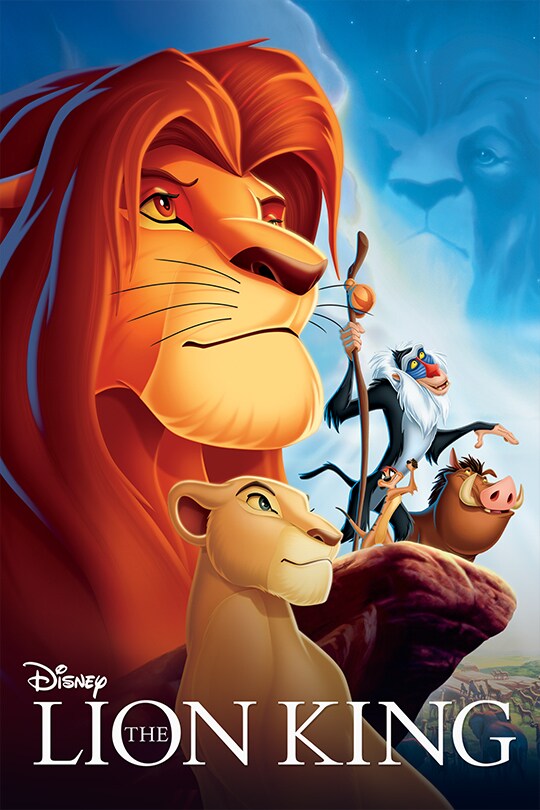
Disney's Lion King (1994)

A young lion prince is cast out of his pride by his cruel uncle, who claims he killed his father. While the uncle rules with an iron paw, the prince grows up beyond the Savannah, living by a philosophy: No worries for the rest of your days. But when his past comes to haunt him, the young prince must decide his fate: Will he remain an outcast or face his demons and become what he needs to be?
The Circle of Life
Scar: I'm surrounded by idiots.
Timon: What do you want me to do, dress in drag and do the hula?
Walt Disney Animation Studios - 2100 Riverside Drive, Burbank, California, USA
Disney-MGM Studios - 351 South Studio Drive, Bay Lake, Florida, USA
Frank Welker provided all the lion roars. Not a single recording of an actual lion roaring was used because the producers wanted specific sounding roars for each lion.
A few weeks before the film opened, Sir Elton John was given a special screening. Noticing that the film's love song had been left out, he successfully lobbied Jeffrey Katzenberg to have the song put back in. Later, "Can You Feel the Love Tonight" won him an Academy Award for Best Original Song.
The team working on the film was supposedly Disney's "team B," who were "kept busy" while "team A" worked on Pocahontas (1995), on which the production had much higher hopes. As it turned out, "The Lion King" became a huge critical and commercial success, whereas "Pocahontas" met with mixed reviews and a much lower box office.
The best-selling home video of all time, with more than 55 million copies sold to date.
(at around 1h 12 mins) The line, "What do you want me to do, dress in drag and do the hula?" was improvised by Nathan Lane.
Continuity
When Nala is crouched in the grass right before she pounces at Pumbaa, her eyes are green. When she's fighting with Simba, her eyes are blue.
The number of whiskers each male lion has changes from scene to scene, and sometimes the whiskers disappear altogether. None of the lionesses in the film have whiskers, though obviously in reality females do have whiskers.
We see Simba scratch Shenzi's cheek, leaving visible cuts, but shortly after, Shenzi is healed.
Grown-up Simba's eyes switch from white to yellow during the movie.
When Scar first begins his speech after Mufasa's death, nine adult lionesses can be made out. However, when the hyenas begin to appear, there are suddenly only eight. The same thing happens when Simba returns to Pride Rock. At first there are six lionesses, then seven, then six again, then only five, then six.
Factual errors
The elephant skeletons would have to come from freakishly large elephants. Hyenas could not pass through the trunk socket of an elephant's skull.
Rafiki the monkey appears to be some sort of bizarre mandrill-baboon hybrid. He has the colorful face of a mandrill, but the long, kinked tail of a baboon (mandrills have very short tails).
The anteaters in the film should be changed to aardvarks because anteaters do not live in Africa they live in South America.
When Simba and Nala meet again as young adult lions, they are heard purring with each other as they rub their heads together. The genus Panthera (lions, tigers, jaguars and leopards) can roar but they are biologically unable to purr. The "small cats" (including cheetahs, mountain lions, lynx and more) can purr, but are unable to roar due to biological differences in their anatomy.
Simba and Nala are both "only children", very rare in lions, which normally have litters of two to four cubs.
Incorrectly regarded as goofs
(at around 21 mins) When Banzai says, "Here, kitty, kitty, kitty," it may appear as though no one is actually speaking. This is because the shot cutting from the cubs to the hyenas is very quick. However, pay close attention only to Banzai's location on the screen: you see his mouth moves when he says "here," and he's audibly saying "kitty, kitty, kitty" through gritted teeth, with his lips shown curled back. If you grit your teeth, curl your lips back, and say this line, you can do so without moving your mouth and it will still sound perfect because you only need to use your tongue to make the sounds.
Simba had apparently spent years eating nothing but bugs while with Timon and Pumbaa yet he becomes a strong and well built adult instead of being malnourished due to lack of meat which is a lion's primary diet. Not only that, but his jaw would be weak and his fangs would be soft causing them to fall out. But a lot of time passes we don't see "on camera." In this time, it's possible he could have hunted for more nourishing meals; he likely learned about hunting for food from his father.
In the film, Scar is given a black mane. A lion with a black mane means he's healthier, more well-fed and stronger. But Scar is the scrawny runt, living off of scraps while the physically-superior Mufasa has the lighter-colored mane. Disney was obviously playing to the bad guys are "darker" trope.
Revealing mistakes
(at around 22 mins) At the end of the elephant graveyard scene, Scar's shadow on the wall does not match his pose. This was corrected in the 2003 Platinum Edition release.
If you look close, when Simba is sitting on the rock during the "Hakuna-Matata" song, the pads on his right paw are bigger then the paw itself.
In the 2011 Diamond Edition release, the clouds that Simba runs towards as his father's spirit disappears were deleted by mistake. This was later corrected in the 2017 Signature Collection Blu-Ray and the 2018 Ultra-HD Blu-Ray releases.
When Scar tells Simba "Remember, its our little secret!", Scar is standing too close to the camera for his legs to be seen, and his position is way outside the ledge and he seems to be standing in mid-air.
When Rafiki parts the grass to show Simba the Dream Pool, he pulls aside the grass on Simba's right (and holds it there). However when Simba passes through the gap, the grass on his left is also pushed aside as if by some invisible hand. It springs back once he's through.
Audio/visual unsynchronized
Before assuming the throne, Simba walks down Pride Rock. Zazu bows to Simba and although his mouth is moving no words are spoken. This is because Zazu was supposed to say "Your Majesty".
While Simba and Nana are walking down the log, Simba says, "Live my own life". While he says this, his mouth doesn't move and is then shown yawning as the word "life" is said.
Errors in geography
Leaf-cutter ants, a gopher and some giant anteaters, all native to the Americas, are shown living happily in Africa. (The gopher should have been a naked mole rat: see trivia.)
(at around 17 mins) During the song 'Can't wait to be King' the monkey grooming Zazu is apparently hanging by its tail. Monkeys with prehensile tails are found only in South America.
Plot holes
In the beginning, Rafiki is shown climbing up the rock to greet Mufasa. But from any other longer shot of the rock, its obvious that there's no way anyone can climb it from the front.
After thinking Simba is "dead" Scar lies to the pride Simba was also killed. Near the climax he asks Simba to tell them who was responsible that Mufasa died. Scar never mentioned this earlier in the film so the pride should had been suspicious on how he "knew" Simba "killed" Mufasa.
How does Scar becoming king somehow affect the weather? Throughout Scar's multi-year reign over the Pride Lands there still should have been some rain going on keep the crops healthy, and rain suddenly poured on the land after Simba defeats Scar and he becomes king. This doesn't make much sense.
Character error
When Simba and Mufasa view the sunrise, they refer to the "shadowy place" as being on their right. As they were facing the sunrise (east) that would mean that anything on the right side would be south. And yet, Scar refers to it later as the place "beyond the northern border."
Rafiki's Swahili chant "Asante sana, squash banana, we we nugu mi mi apana" does not mean "You are a baboon, and I'm not." Nor does it mean "You are a dog, and I'm not," as has sometimes been suggested. Neither the Swahili for baboon, nyani, nor the Swahili for dog, mbwa, appear in the song.
After Zazu is blown away by the hyenas he apparently alerts Mufasa that Simba and Nala are in danger and Mufasa comes to the rescue in just a few minutes but given Mufasa was in the Pride Lands it should have taken him longer to get the elephant graveyard.
When Mufasa's ghost appears to Simba, he doesn't tell him Scar killed him, which would have saved Simba trouble when he later confronts him.