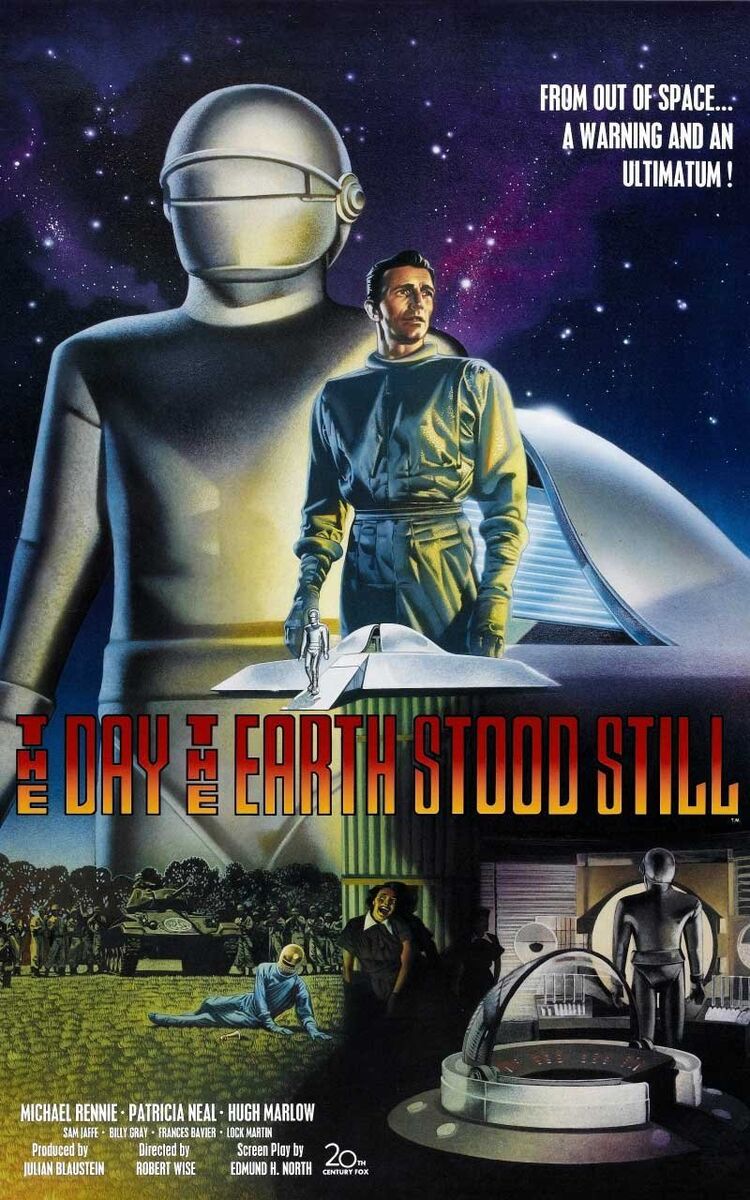
The Day The Earth Stood Still (1951)

Travelling at mind-boggling speed, a gleaming unidentified flying object zooming in from boundless deep space penetrates the Earth's atmosphere, landing smoothly in Cold War Washington, D.C. Encircled by large yet feeble military forces, the peaceful intergalactic ambassador, Klaatu, emerges from the mysterious vessel accompanied by the silently dangerous robot of incomprehensible power, Gort, only to witness firsthand the earthlings' hospitality. The sophisticated humanoid declares that he comes in peace; however, he needs to assemble the world's greatest minds to hear his merciful warning and a definitive ultimatum. Is Klaatu the messenger of humanity's doom?
A robot and a man . . . hold the world spellbound with new and startling powers from another planet!
Helen: Gort! Klaatu barada nikto!
RKO Encino Ranch - Balboa Boulevard & Burbank Boulevard, Encino, Los Angeles, California, USA
The Ellipse, National Mall, Washington, District of Columbia, USA
(landing of the flying suacer on the oval)
Washington, District of Columbia, USA
The role of Klaatu was originally intended for Claude Rains.
The role of Gort was played by Lock Martin, the doorman from Grauman's Chinese Theater, because he was extremely tall. However, he was unable to pick up Helen because he was so weak and had to be aided by wires (in shots from the back where he's carrying her, it's actually a lightweight dummy in his arms). He also had difficulty with the heavy Gort suit and could only stay in it for about a half-hour at a time.
There were two Gort suits: one that laced up down the back for when he had his front to the camera, another that laced up in the front for the shots of his back.
To give the appearance of seamlessness to the space ship, the crack around the door was filled with putty, then painted over. When the door opened the putty was torn apart, making the door seem to simply appear.
During the early phases of preproduction, 20th Century Fox's studio chief Darryl F. Zanuck suggested that Jack Palance could be used for the role of the robot Gort.
Patricia Neal has admitted in interviews that she was completely unaware during the filming that the film would turn out so well and become one of the great science-fiction classics of all time. She assumed it would be just another one of the then-current and rather trashy flying saucer films that were popular at the time, and she found it difficult to keep a straight face while saying her lines.
One of the reasons that Michael Rennie was cast as Klaatu was because he was generally unknown to American audiences, and would be more readily accepted as an "alien" than a more recognizable actor.
In the original story, the robot, Gort, was the master - Klaatu was merely one of a series of doubles, or maybe clones, that died after a short time.
In the original story, "Farewell to the Master", the robot's name was Gnut, not Gort.
Doubles were used for Klaatu and Bobby in long shots of them walking around Washington, DC. In reality, none of the principal cast ever went to Washington, and the scenes with Klaatu and Bobby at the Lincoln Memorial and at Arlington Cemetary were shot in front of background screens using footage shot by the second unit crew in Washington, DC.
All of the scenes of Helen Benson and Klaatu in the taxi also feature footage from the second unit of Washington, DC as we see background vehicles in the rear and side windows of the taxi.
To depict the seamless closing of the ship and its ramp, they just reversed the film of the shot of the ship's ramp and door appearing.
The original choice of actor to play the alien visitor was Spencer Tracy.
Darryl F. Zanuck was the one who first suggested Michael Rennie for the part of Klaatu, having seen him perform on the London stage.
Robert Wise was attracted to the project because of its overt anti-military stance and also because he believed in UFOs.
In line with the film's Christian allegory, Klaatu adopts the name "Carpenter" when hiding out from the authorities. Robert Wise hadn't considered the Christian implications until it was pointed out to him several years later.
The spaceship was made of wood, wire and plaster of Paris.
The Army refused to co-operate after reading the script. The National Guard had no such qualms and gladly offered their co-operation.
The screenplay was based on the story "Farewell to the Master" by Harry Bates. It was originally published in the pulp magazine "Astounding Science-Fiction."
Three years after this was made, it was adapted for the "Lux Radio Theatre". Michael Rennie and Billy Gray reprised their roles. Jean Peters played the role of Helen.
Bernard Herrmann's music for the film is scored for two theremins, pianos, harps, different electrical organs, percussion, amplified solo strings and a large brass section including four tubas.
Although he was already signed to play the Einstein-like Professor Barnhardt, the studio wanted to remove Sam Jaffe as a result of the political witch hunts that were then underway. Producer Julian Blaustein appealed to studio chief Darryl F. Zanuck. Zanuck allowed Jaffe to play the role, but it would be Jaffe's last Hollywood film until the late 1950s.
Bernard Herrmann used two Theremins to create his creepy score, one pitched higher, the other lower, making this one of the first films to feature a largely electronic score.
Ranked #5 on the American Film Institute's list of the 10 greatest films in the genre "Sci-Fi" in June 2008.
To increase the sense of reality, some of the most famous broadcast journalists of the time were hired to do cameos as themselves. These included Gabriel Heatter, H.V. Kaltenborn and Drew Pearson.
Originally Klaatu's death and resurrection at the end of the movie was meant to be permanent, reinforcing his God-like powers, but at the time the Breen Office--the film industry's censors--didn't like the ending, suggesting it was too left-wing, and insisted that director Robert Wise and writer Edmund H. North put in the line, "That power is reserved for the Almighty Spirit". Both Wise and North hated the line and thought it completely inappropriate--negating the concept of Klaatu's race being all-knowing and all-powerful--but the studio wouldn't back them up and they were forced to put it in.
In the scene where Gort is seen carrying Klaatu's body (inside the ship), Michael Rennie was actually sitting on a dolly out of camera angle to support his weight during this brief scene, since Lock Martin (Gort) was unable to do so himself.
In the scenes of Gort carrying both Helen Benson and Klaatu up the ramp and into the ship, lightweight look-alike dummies were used because of Lock Martin's inability to actually carry either actor himself.
One scene was cut from the movie before it was released. The original script called for Klaatu to be taken to a police station by the government man who came for him at the boarding house, not directly to Barnhart's home. At the station, men were being dragged in from all over and questioned, and Klaatu becomes upset when he sees how a man was beaten up by a crowd because they thought he was the spaceman. The scene was cut because director Robert Wise realized that the audience was interested in the Klaatu/ Barnhart meeting and the scene at the police station was unnecessary, but on the DVD there are stills from that deleted scene.
Because the stationary Gort could not stand on the angled ramp, Lock Martin had to wear the Gort suit in the background during the final sequence. Martin, who was frail, had to wear the suit for so long that he began having spasms in his arms. During Klaatu's final speech, Gort's arms can be seen moving slightly.
Harry Bates was paid a mere $500 by 20th Century-Fox for the rights to his short story "Farewell to the Master".
The name "Richard Carlson" - another leading sci-fi actor of the 1950s - appears at the bottom of the glass door to Hugh Marlowe's office.
Some reference works state that "Adventures of Superman" (1952) star George Reeves appeared as a television news reporter with eyeglasses in one sequence. This is not true. The actor playing the role bears no resemblance to Reeves, and in a 1995 interview with Reeves biographer Jim Beaver, director Robert Wise stated unequivocally that it is not Reeves in the role. It appears that someone jumped to conclusions based on the image of a reporter wearing glasses and thus resembling roughly the image of Superman alter-ego Clark Kent. Reeves had nothing to do with the film in any capacity.
The phrase "Klaatu barada nikto" has become a popular phrase among sci-fi fans over the years and has been featured in other movies, such as Army of Darkness (1992).
The film was shot on the 20th Century-Fox back lot, which is now an upscale office complex known as Century City.
Writer Edmund H. North was a former army officer who wrote the script in response to the proliferation of nuclear weapons during the Cold War.
In 1951, 20th Century Fox theatrically distributed this with the short film The Guest (1951).
Whether the makers of the movie intended or not, there is a striking resemblance between Klaatu and the head of the Manhattan Project, Robert Oppenheimer. Oppenheimer was known to make corrections on the blackboards of theoreticians at the Project, similar to the scene where Klaatu corrects the work of Professor Barnhardt. Oppenheimer's other-worldly brilliance and association with destructive power that could threaten the existence of the world seem like more than a coincidence.
Continuity
After the electricity is neutralized, there's a motorcycle cop trying to start his motorcycle and the traffic light on the left side of the shot is lit.
During the montage shots of newspaper headlines during the hunt for Klaatu, a photograph shows him still standing on his ship holding out the viewing device which was shot out of his hand. During the earlier scene of his emergence from the saucer, he didn't produce the device until leaving the ramp and approaching the onlookers.
When Klaatu visits Dr. Barnhardt in the evening, there is a small piece of paper pinned to one side of the blackboard, the left side. On the paper is seen (briefly) "Do Not Erase." A few moments later in the same scene, there is no paper pinned to the side of the blackboard. Again, in the same scene, the paper is back very briefly, but just as before, disappeared almost immediately.
Bobby's room is clearly shown to be at the top of the staircase, and Helen's room is down the hall. However, in the shot where Helen is seen getting her coat from her room to go out with Tom to the movies, the top of the staircase can be clearly seen just outside of her door when it should be down the hall and much farther away from her room.
During the power outage, Professor Barnhardt's secretary excitedly tells him that the whole city has stopped and people are running around like ants. But the view out the window behind the professor shows only two people - one in the foreground and one farther back - both casually strolling along the street.
Factual errors
When the army is hunting for Klaatu the Colonel receives the license plate number and repeats it for broadcast as H0012. It should have been read as "Hotel" 0012" in accordance with the Military Alphabet Code.
Bobby's father's tombstone says Lt. Robert Benson was with the 45th Infantry Regiment of the 3rd Infantry Division and died at Anzio. The division fought at Anzio, but the 45th Infantry was not part of the 3rd Division.
When Gort puts Klaatu into the "life-regeneration" device, the blood stain on Klaatu's suit coat reveals no bullet hole present.
Klaatu gives Bobby several diamonds and tells him they're what his planet uses for money. However, the diamonds have the classic American Brilliant cut. This would be a very odd design for an alien civilization 250 million miles away.
The supposed celestial mechanics equations on the blackboard are nonsensical gibberish, none of them make any sense, especially the zeros with the exclamation points at the bottom.
Incorrectly regarded as goofs
Some suggested that it was impossible for Klaatu to have learned handwriting via radio; however, TV broadcast is also a form of radio wave.
Just after Klaatu has been shot and is in the hospital, he is visited by a government official. Klaatu states he has traveled "five of your Earth months" and "250 million of your Earth miles". 250 million miles would put his starting point between Mars and Jupiter, depending on when you measure. However, at the far end of the scale, Mars itself can be 250 million miles from Earth.
In some long shots of Gort walking, wrinkles in the legs of the costume are clearly visible. However, it could be that Gort is made from a very flexible kind of metal that is completely unknown on Earth.
When Bobby is doing his math homework, Klaatu looks over his shoulder and says: "All you have to remember is, first find the common denominator, then divide." Division of fractions doesn't require a common denominator. In fact, the original script says "subtract". (However, Klaatu's method could work. e.g. To divide 1/3 by 1/4 find the common denominator and re-express as 4/12 divided by 3/12. Then simply divide the 4 by 3 to get the answer -- 1 and 1/3.
In Klaatu's hospital room, the light switch is on the wrong side of the door. Normally, the light switch would be on the same side as the door knob so the light could be turned on as you entered the room. While ergonomics is usually considered in structures, it is not an absolute (as indicated by "Normally"), especially in older buildings.
Revealing mistakes
At the beginning, H.V. Kaltenborn mentions the 'beautiful spring weather' in the nation's capital, but later it is revealed to be July (Klaatu sees a dry cleaner's receipt on his suit dated 7-18-1951). In spite of the spring and summer references, when Klaatu and Billy walk around Washington, many of the trees are still bare as they had yet to regain their leaves. (Filming had started early in the year.)
When the military are trying to cut through the metal of the spaceship, a square of asbestos material taped to the ship can be seen, presumably to protect the wooden spaceship from the flame of the cutting torch.
When Klaatu returns to the ship at night to contact his people, Gort is shown from the front after he knocks out the two soldiers. There is no cut-away as Gort turns to open the ship's ramp for Klaatu, and the zipper in the back of the rubber suit can plainly be seen as Gort walks towards the ship before he turns around to face front again.
When Gort goes to collect Klaatu, he passes Helen as he walks to the door of the central room in the spaceship and what looks like a large rip can be seen in the front of his otherwise solid-looking left leg.
In the shots from behind of Gort carrying first Helen, and later Klaatu, into the spaceship, the people being carried are clearly dummies - or rather, one dummy dressed first in Helen's and later Klaatu's clothing.
Audio/visual unsynchronized
In the close-up of the quick-triggered soldier atop the tank turret, he fires his pistol, but for the sharp-eyed, the wide-shot of the tank crew that follows, reveals the visible, but silent ,muzzle flash of both soldiers' side arms.
In one scene near the end, the sound of an airplane approaching can be heard, then there is a cut to another angle and the sound is absent.
Errors in geography
Klaatu arranges to have the electromagnetic fields neutralized from 12.00 pm to 12:30 pm EST, yet it is clearly broad daylight in every country in which people are struggling with inoperative devices. In Asia and the Middle East, it should've been nightfall during this time frame.
When Helen and Klaatu are going to the professor's, the army states that their cab is heading northwest on Connecticut at Columbia Rd. The cab then passes under the Dupont Circle underpass on Connecticut AV. The underpass is south of Columbia Rd, not north. Also, if the professor lives near the State Department, they are going in the wrong direction. The State Department offices are south of Columbia Rd.
The fat man running crying, "They landed in the Mall," is wrong. The Mall is a long relatively narrow strip of land stretching from the Capitol Building and the Washington Monument. Yet Klaatu sets his saucer down in a square field with the South Face of the White House clearly visible at the edge of frame which means it is The Ellipse in President's Park. Furthermore, there are three baseball diamonds present: there are no baseball diamonds at the Mall. location.
As the spaceship races across the world, scenes of successive radio announcers (or people listening to them) are shown, apparently in order of their broadcasts. When the BBC announcer in England is shown delivering his broadcast, the clock behind him reads 8:33 (p.m.). The next shot shows radio commentator H.V. Kaltenborn doing his broadcast from Washington, D.C. The clock behind him reads 3:24. Since Washington is five hours behind London, and assuming the broadcasts were indeed shown in order, Kaltenborn's clock should have read no earlier than 3:33, and probably a minute or more later than that.
When the military is tracking Klaatu in the Yellow Cab, the radio call states that they a proceeding west on 15th Street. In Washington DC, numbered streets run North/South.
Plot holes
Not all vehicles would have been stopped by the power outage. Diesel engines, particularly at that time, don't need electricity to run. This would also explain why a boat can be seen moving in one shot.
There are some conflicts in dates. The announcer says there are signs of spring. The dry cleaning tag has the date 7-18-1951 which is the middle of summer. Bobby asks if he can stay home from school so the date cannot be in the summer, since in those days there was no summer school for elementary school students.
When Klaatu boards his ship at night to arrange the electricity neutralization demonstration for the next day, he could simply have stayed on board where he was safe and emerged for the meeting the next evening. It made no sense for him to go back to the boarding house where, by his own admission, he was in danger.
Beth displays a complete lack of parental concern as she allows Klaatu, going under the name of Mr Carpenter, a strange man who simply shows up at the boarding house the night before, who shows no identification to anyone, to spend the day with Bobby, her underage son. She even tells Carpenter how nice it is for him to suggest it.
Carpenter asks Helen what Bobby told her the night before, but he could not possibly know that Bobby saw or said anything the night before since he was still out when Bobby went to bed, and had he seen Bobby in the morning he could have asked him.
Character error
Klaatu tells Professor Barnhardt that he was in room 309 of Walter Reed Hospital, but the number on his hospital room door is 306.
The British radar man says it's moving at 4,000 mph. Then says it must be a Buzzbomb. As a British radar man, he'd know that the Buzzbomb only flew at 360 mph. 75% were shot down by the Royal Air Force.
A colonel orders his troops to block off all streets intersecting Connecticut Avenue "along a line from Wisconsin to the park." Connecticut Avenue and Wisconsin Avenue do not intersect.
Klaatu spends a couple of days wandering round Washington DC and listening to the radio with the lodgers, then claims 'his patience is wearing thin'.
When the MP and nurse enter Klaatu's hospital room and find him missing, they are shocked and react in a panic as soon as they enter, without really looking around the room.